One of my dearest friends and followers asked me to explain what we do as Ham/Amateur Radio Operators. So this post is devoted to the subject of Ham Radio and what we do. First let me define Amateur Radio per the ARRL: “Amateur Radio (ham radio) is a popular hobby and service that brings people, […]
A Mystery Frequency Disrupted Car Fobs in an Ohio City, and Now Residents Know Why By Heather Murphy AC2UQ May 2019 in Official OMARC News A Mystery Frequency Disrupted Car Fobs in an Ohio City, and Now Residents Know Why By Heather MurphyMay 4, 2019 Virginia Avenue in North Olmsted, Ohio, where residents complained that their car […]
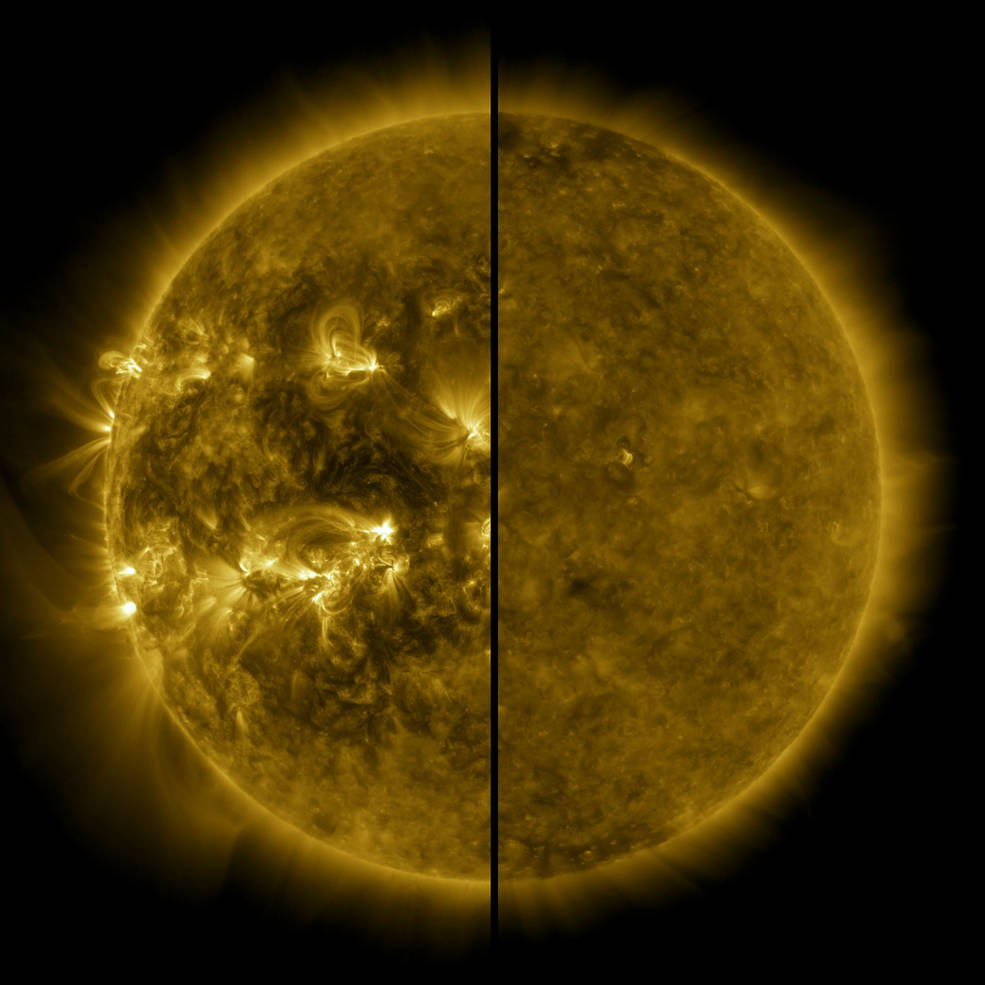
This split image shows the difference between an active Sun during solar maximum (on the left, captured in April 2014) and a quiet Sun during solar minimum (on the right, captured in December 2019). December 2019 marks the beginning of Solar Cycle 25, and the Sun’s activity will once again ramp up until solar maximum, predicted for 2025.
Credits: NASA/SDO
“Solar Cycle 25 has begun. During a media event on Tuesday, experts from NASA and the National Oceanic and Atmospheric Administration (NOAA) discussed their analysis and predictions about the new solar cycle – and how the coming upswing in space weather will impact our lives and technology on Earth, as well as astronauts in space.” — NASA
While people might think of some negative impact or other, to Amateur Radio Operators it’s a good thing. The greater the number of sunspots, the better radio waves propagate in the High Frequency (HF) bands.
The sunspot maximum is predicted for July 2025, according to the Press Release.
Page Two
It was during the minimum sunspot activity of Solar Cycle 21 that I was licensed by the Federal Communications Commission (FCC) and given the call sign N6BVZ. While learning Morse Code for the exam, I built a low-power transceiver—a HeathKit HW-8. I set up a vertical antenna on top of my trailer. I listened a lot as I waited.
When my license came in the mail, I got on the air. I had no idea the bands were not suppose to be good, that it would be hard to make any contacts. I tuned around on a band that had some noise on it, indicating that some activity might be present.
Finally the moment came. A fellow in Texas was sending CQ (which is an invitation to anyone to answer and “talk.” Talk meant using Morse Code and a key to send dits and dots. My speed then was about 5+ words per minute.
I didn’t hesitate to send my call. I heard him reply with my call. He’d heard me. The signal was a bit off from where I was tuned, and I started to retune as I readied to reply. Calamity! I managed to slip and push the dial way off. I tried to get back to the spot, but couldn’t find him again.
After a bit I found another station calling CQ, answered, and we had a short QSO (conversation or contact). Despite my initial blunder, I got off to a pretty good start, making a lot of contacts over the next few years.
Eventually the Solar Cycle got really good, as it hit maximum. I made contacts in Europe and even Australia, as well as all over the United States.
Those first years were my best years in Ham Radio (a nickname for Amateur Radio).


 Jonah’s Song