Wednesday Begins with “W”: When All Else Fails

“Amateur Radio (ham radio) is a popular hobby and service that brings people, electronics and communication together. People use ham radio to talk across town, around the world, or even into space, all without the Internet or cell phones. It’s fun, social, educational, and can be a lifeline during times of need.” —ARRL
ARRL provides a wealth of information about Amateur Radio, what it is, the services Amateur Radio Operators provide around the world, how to get involved, and more.

My introduction to Amateur Radio came through a neighbor sometime in the early 1970s. Talking to my father at some point I discovered that my Godfather was operated Amateur Radio, and that my dad had once learned morse code. It took a few years, but after a fair amount of studying electronics theory and learning morse code—today there is less intense theory and no code required for a license—I earned my technician-class license.

The first radio I built was a kit, a Heathkit HW8, which allowed me to operate using morse code. It didn’t take long for me to gain morse code speed, and pass the FCC code test for license upgrade to General Class. With the upgrade, I was allowed to operate on a larger portion of the radio spectrum, and to operate with voice communications, as well as code.

Over the last forty something years I’ve talked with people from around the world from home, from various vehicles I’ve owned, from my Semi, from my sailboat, and from park benches.

Today there is a growing number of Amateurs who operate from State Parks and from mountain tops. With the increase of restrictions for antennas in neighborhoods, operators have found open spaces to set up temporary antennas in parks and mountains. It’s an added challenge, too, to operate from a small battery and a low-powered radio, that often is carried in a backpack.

Amateur Radio has allowed me to be involved in Emergency Services. Amateurs train for services during disasters by providing communications for a variety of events, such as parades, marathons, bicycle races, and more. During disasters they provide critical communications for those assisting in recovery efforts.

Many Amateurs “check in” to nets, making friends over the air waves. Nets are general moderated round table gatherings of people who chat on a particular radio frequency and a specified time, daily or weekly.
While there aren’t a lot of Christian nets, there are enough to enable casual listeners to hear Christians sharing scriptures and experiences with one another. This is one form of evangelism aimed at the Amateur Radio Operator Community. It is also a time of fellowship between Operators. A few of the groups gather for a long weekend during the summer in which they can further their friendships.


What Ham Radio Operators Do — Padre Tatro’s Study

One of my dearest friends and followers asked me to explain what we do as Ham/Amateur Radio Operators. So this post is devoted to the subject of Ham Radio and what we do. First let me define Amateur Radio per the ARRL: “Amateur Radio (ham radio) is a popular hobby and service that brings people, […]

What Ham Radio Operators Do — Padre Tatro’s Study

It’s Official, Solar Cycle 25 is Here

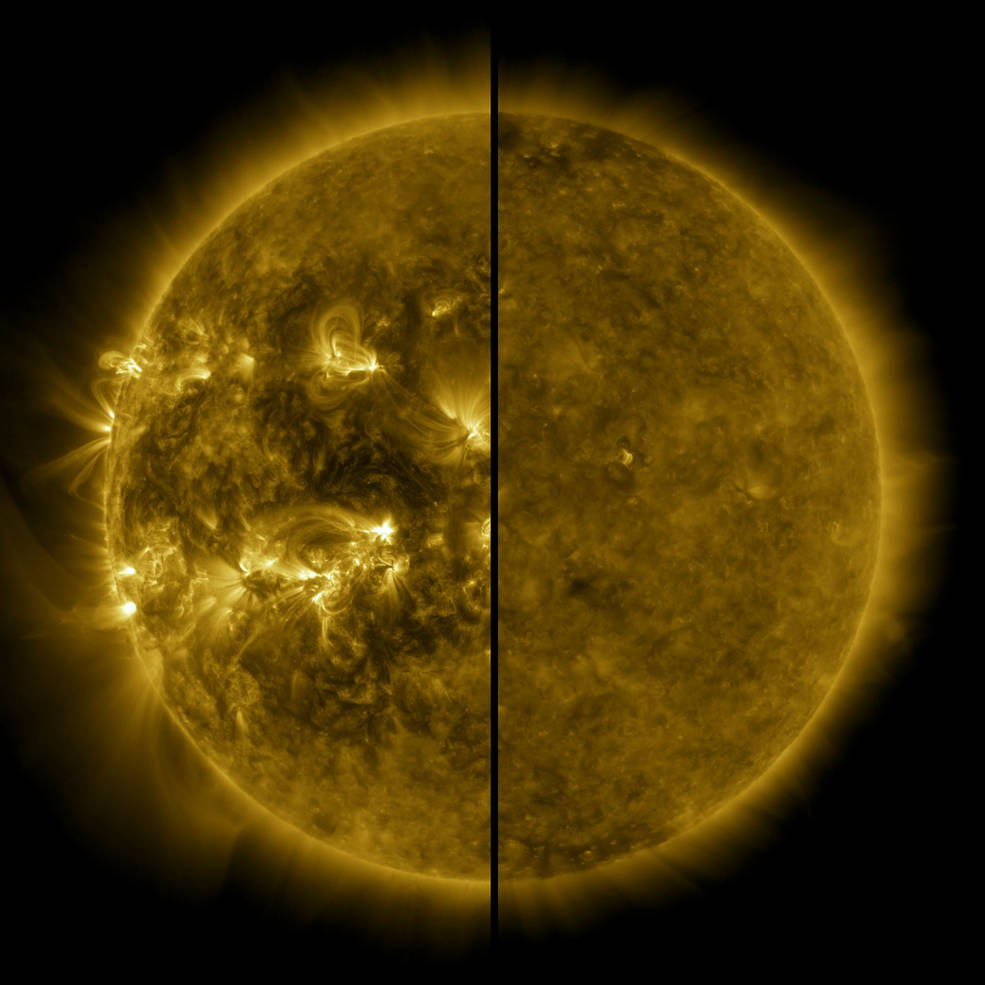
This split image shows the difference between an active Sun during solar maximum (on the left, captured in April 2014) and a quiet Sun during solar minimum (on the right, captured in December 2019). December 2019 marks the beginning of Solar Cycle 25, and the Sun’s activity will once again ramp up until solar maximum, predicted for 2025. Credits: NASA/SDO

“Solar Cycle 25 has begun. During a media event on Tuesday, experts from NASA and the National Oceanic and Atmospheric Administration (NOAA) discussed their analysis and predictions about the new solar cycle – and how the coming upswing in space weather will impact our lives and technology on Earth, as well as astronauts in space.” — NASA

While people might think of some negative impact or other, to Amateur Radio Operators it’s a good thing. The greater the number of sunspots, the better radio waves propagate in the High Frequency (HF) bands.

The sunspot maximum is predicted for July 2025, according to the Press Release.


Page Two


It was during the minimum sunspot activity of Solar Cycle 21 that I was licensed by the Federal Communications Commission (FCC) and given the call sign N6BVZ. While learning Morse Code for the exam, I built a low-power transceiver—a HeathKit HW-8. I set up a vertical antenna on top of my trailer. I listened a lot as I waited.

When my license came in the mail, I got on the air. I had no idea the bands were not suppose to be good, that it would be hard to make any contacts. I tuned around on a band that had some noise on it, indicating that some activity might be present.

Finally the moment came. A fellow in Texas was sending CQ (which is an invitation to anyone to answer and “talk.” Talk meant using Morse Code and a key to send dits and dots. My speed then was about 5+ words per minute.

I didn’t hesitate to send my call. I heard him reply with my call. He’d heard me. The signal was a bit off from where I was tuned, and I started to retune as I readied to reply. Calamity! I managed to slip and push the dial way off. I tried to get back to the spot, but couldn’t find him again.

After a bit I found another station calling CQ, answered, and we had a short QSO (conversation or contact). Despite my initial blunder, I got off to a pretty good start, making a lot of contacts over the next few years.

Eventually the Solar Cycle got really good, as it hit maximum. I made contacts in Europe and even Australia, as well as all over the United States.

Those first years were my best years in Ham Radio (a nickname for Amateur Radio).


L-RD Bless, Keep, Shine. . .


Have you every heard a stone cry out?

This symbol is presumably recognized worldwide...
This symbol is recognized worldwide as signifying amateur radio. (Photo credit: Wikipedia)

The other day, an acquaintance said that his neighbor, who is also an amateur radio operator, told him the hobby is dying out as a result of cell phones and internet. I disagree. I told him that hams are very inventive people, and that experimentation with new electronic communications is ongoing. Radio communications became possible through the vibrations, or oscillations, of a tiny piece of crystal—a small rock—to which electricity is applied. The size of the crystal determined the rate of vibration, its frequency. Today, no longer bound to crystals, receivers and transmitters have a large spectrum of frequencies available to tune across with one radio.

I’ve enjoyed ham radio since the mid-1970s and am continually amazed how this “hobby” has evolved to include satellites and a worldwide email system. Despite the modern advances, the old methods still prevail: moving the tuning dial on a receiver, listening for someone calling “CQ,” which is a general invitation to talk, and then broadcasting an answering call. Yes, ham radio is really the first Social Media, predating Facebook by a hundred years.

One of my favorite activities is the Bible nets. Nets are gatherings of hams on a particular frequency (sort of like a channel) at a particular time and day. There is one called the Bible Fellowship Network that operates daily very early in the morning. There are other Bible nets that operate in the afternoons. Bible nets are usually a round table affair with hams commenting on a scripture, giving a report on something for which they wish to praise the Lord, or requesting prayer and being prayed for over the air waves.

Given radios humble beginnings with a crystal vibrating, is it too much of a stretch to say that rocks to cry out?

I tell you that, if these should hold their peace, the stones would immediately cry out.

Luke 19:40
Lord Bless, Keep, Shine. . .