Song of Ascent: Fifteenth Step

At the Western Wall, upon which The Temple once stood, people gather to listen to a man’s prayers.
by Wil Robinson. 1987

Song of Ascent. Psalm 130

1 Come, bless the LORD, all you servants of the LORD, who stand by night in the house of the LORD!

2 Lift up your hands to the holy place and bless the LORD!

3 May the LORD bless you from Zion, he who made heaven and earth!

The final step, what a wonderful and joyous call! It’s an invitation. The call is for me. The call is for you. Are we not grateful we are called? Jew and Gentile alike. A call by our Heavenly Father made possible by His Son, our Savior, Yeshua Jesus! Blessed be His Name forever!

The pilgrim bands arriving at the sanctuary call on the priests, who stand in the house of the Lord—at the time of the evening sacrifice, to unite in praising God in their name and that of the people, using appropriate gestures, to which the priests reply, pronouncing the Mosaic blessing which they alone could pronounce. A fit epilogue to the whole pilgrim-book, Psalms 120-134. —Jamieson-Fausset-Brown Bible Commentary

Priestly Blessing

Song of Ascent: Fourteenth Step

At The Western Wall, Jews and Christians gather during The Feast of Sukkot (Tabernacles).
by Wil Robinson. 1987

Song of Ascents.
Of David. Psalm 133

1 Behold, how good and pleasant it is when brethern dwell in unity!

2 It is like the precious oil on the head, running down on the beard, on the beard of Aaron, running down on the collar of his robes!

3 It is like the dew of Hermon, which falls on the mountains of Zion! For there the LORD has commanded the blessing, life forevermore.

The first verse is beloved by many, and contained in favorite praise songs.

How lovely if we could hear the joyous voices of Levites on this fourteenth step of their ascent.

“. . .unity among brethren, whether civil or religious, is productive both of profit and pleasure. Of profit, because therein consists the welfare and security of every society; of pleasure, because mutual love is the source of delight, and the happiness of one becomes, in that case, the happiness of all. It is unity alone which gives beauty, as well as strength, to the state; which renders the church, at the same time, fair as the moon, and terrible as an army with banners, Song of Solomon 6:10.” — Horne, as quoted in Benson Commentary.

Priestly Blessing

Song of Ascent: Thirteenth Step

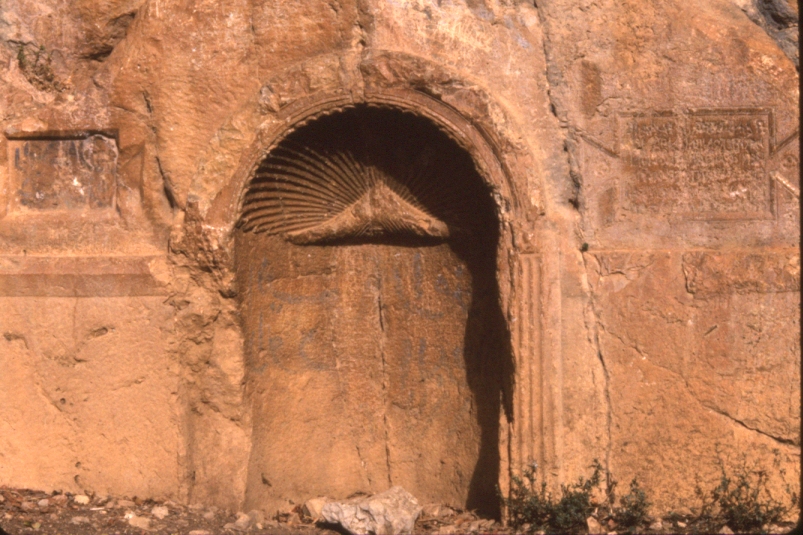
A blocked doorway. Temple Mount.
by Wil Robinson. 1987

Song of Ascents. Psalm 132
1 Remember, O LORD, in David’s favor, all the hardships he endured,
2 how he swore to the LORD and vowed to the Mighty One of Jacob,
3 “I will not enter my house or get into my bed,
4 I will not give sleep to my eyes or slumber to my eyelids,
5 until I find a place for the LORD, a dwelling place for the Mighty One of Jacob.”
6 Behold, we heard of it in Ephrathah; we found it in the fields of Jaar.
7 “Let us go to his dwelling place; let us worship at his footstool!”
8Arise, O LORD, and go to your resting place, you and the ark of your might.
9 Let your priests be clothed with righteousness, and let your saints shout for joy.
10 For the sake of your servant David, do not turn away the face of your anointed one.
11 The LORD swore to David a sure oath from which he will not turn back: “One of the sons of your body I will set on your throne.
12 If your sons keep my covenant and my testimonies that I shall teach them, their sons also forever shall sit on your throne.”
13 For the LORD has chosen Zion; he has desired it for his dwelling place:
14 “This is my resting place forever; here I will dwell, for I have desired it.
15 I will abundantly bless her provisions; I will satisfy her poor with bread.
16 Her priests I will clothe with salvation, and her saints will shout for joy.
17 There I will make a horn to sprout for David; I have prepared a lamp for my anointed.
18 His enemies I will clothe with shame, but on him his crown will shine.”

Do not the Levites step up and view The Temple and sing of a time when the The Ark was lost, and when found, remained in a tent?

They sing, too, of King David’s guilt at himself having a palace but no lasting House for Adonai.

Jewish commentators believe this is a “prayer David composed upon discovering the future site of the Bet Ha’mikdash (The Temple). As we read in the Book of [Samuel II (chapter 24) and the Book of Chronicles I (chapter 21), G-D delivered a deadly plague upon the Jewish people, and the prophet instructed David that he could end the plague by offering sacrifices in the granary of a Jerusalemite named Aravna (who was also known as Arnan). David purchased the land, built an altar and offered sacrifices, and the plague immediately came to an end. Thereupon David declared, “This is the House of the L-RD G-D, and this is Israel’s altar for burnt offerings!” [Chronicles I 22:1]. Indeed, that spot became the site on which the Bet Ha’mikdash was built during the time of David’s son and successor, King Solomon.”—Daily Tehillim.

In verse 14, according to Expositors Bible Commentary, “the psalmist asked for favor to the anointed, and God replies by expanded and magnificent promises. The “horn” is an emblem of power.”

And “Victory will attend the living representative of David, his foes being clothed by [G-D] with shame-i.e., being foiled in their hostile attempts-while their confusion is as a dark background, against which the radiance of his diadem sparkles the more brightly. These large promises are fulfilled in Jesus Christ, of the seed of David; and the psalm is Messianic, as presenting the ideal which it is sure shall be realized. and which is so in Him alone.

Priestly Blessing

Song of Ascent: Twelfth Step

Child in Old City Jerusalem.
Photo by Wil Robinson. 198
8

Psalm of Ascent. Psalm 131

1 O LORD, my heart is not lifted up; my eyes are not raised too high; I do not occupy myself with things too great and too marvelous for me.

2 But I have calmed and quieted my soul, like a weaned child with its mother; like a weaned child is my soul within me.

3 O Israel, hope in the LORD from this time forth and forevermore.

On this step, we hear the Levites sing a song of David in which he “briefly testifies that he did not conduct himself with the kind of arrogance and egotism that are generally associated with leadership and author.” (Daily Tehillim)

All who govern are under the ultimate authority of G-D. Israel’s King David modeled the proper relationship of a governor, which is one of being a dependent subject to the G-D of Abraham, Isaac, Jacob, the Father of Yeshua our Messiah and King.

Priestly Blessing

Song of Ascent: Eleventh Step

Looking down, 2500-year-old stones in an excavated area of Old City Jerusalem.
Self-Portrait. Wil Robinson. 1987

Song of Ascent. Psalm 130
1 Out of the depths I cry to you, O LORD!
2 O Lord, hear my voice! Let your ears be attentive to the voice of my pleas for mercy!
3 If you, O LORD, should mark iniquities, O Lord, who could stand?
4 But with you there is forgiveness, that you may be feared.
5 I wait for the LORD, my soul waits, and in his word I hope;
6 my soul waits for the Lord more than watchmen for the morning, more than watchmen for the morning.
7 O Israel, hope in the LORD! For with the LORD there is steadfast love, and with him is plentiful redemption.
8 And he will redeem Israel from all his iniquities.

In their ascent from the Court of the Gentiles, the Levites step now onto the eleventh step. They enter the last section of five steps.

The Expositor’s Bible Commentary begins:
“In a very emphatic sense this is a song of ascents, for it climbs steadily from the abyss of penitence to the summits of hope. It falls into two divisions of four verses each, of which the former breathes the prayer of a soul penetrated by the consciousness of sin, and the latter the peaceful expectance of one that has tasted God’s forgiving mercy. These two parts are again divided into two groups of two verses, so that there are four stages in the psalmist’s progress from the depths to the sunny heights.”


Priestly Blessing