Song of Ascent: Sixth Step

Looking north from one hill–I believe Talpiot–over Jerusalem’s Old City to the hills on the north. To the left is the new city Jerusalem. [I love this shot of the Bedouin shepherd with his sheep, and the Jewish father with his child in the stroller.] Photo by Wil Robinson 1986

A Song of Ascent. Psalm 125

1 Those who trust in the LORD are like Mount Zion, which cannot be moved, but abides forever.
2 As the mountains surround Jerusalem, so the LORD surrounds his people, from this time forth and forevermore.
3 For the scepter of wickedness shall not rest on the land allotted to the righteous, lest the righteous stretch out their hands to do wrong.
4 Do good, O LORD, to those who are good, and to those who are upright in their hearts!
5 But those who turn aside to their crooked ways the LORD will lead away with evildoers!
Peace be upon Israel!


The Levites take their sixth step and I wonder if they didn’t look around at the mountains surrounding Jerusalem. I wonder if in the gaze they thought of their progress so far.

On the first step we heard them cry from Psalm 120 for deliverance from lying tongues, false witnesses. Then concluding with the complaint: “Too long have I had my dwelling among those who hate peace. I am for peace, but when I speak, they are for war!”

Are not their voices echoing from those hills– an assurance that our help comes only from our L-RD, for our true salvation comes from G-D’s Anointed One, Yeshua. “The LORD will keep your going out and your coming in from this time forth and forevermore.”

Can we forget the joy in the Levites’ voices as they set their feet upon the third step? They exhorted us to “give thanks to the Name of the L-RD”

And then a very personal declaration issued on the fourth step as their hearts turned heavenward. They sang “To you I lift up my eyes, O you who are enthroned in the heavens!”

Did not the Levites call to us on that fifth step when they cried out, “We have escaped like a bird from the snare of the fowlers; the snare is broken, and we have escaped!” And their testimony to us, their encouragement to us, “Our help is in the name of the L-RD, who made heaven and earth.”

On this sixth step do we not sing along with the Levites Psalm 125, for we understand what they’ve said? With them, can we not sing too, “As the mountains surround Jerusalem, so the L-RD surrounds his people, from this time forth and forevermore”?

The final verse from Psalm 125 gives a warning: “But those who turn aside to their crooked ways the L-RD will lead away with evildoers!” Isaiah (59:8) gave a similar warning: “The way of peace they know not; and there is no judgment in their goings: they have made them crooked paths: whosoever goeth therein shall not know peace.”

Their crook ways. That caught my attention, as it did a Bible commentary that wrote: “their—is emphatic; the “crooked ways” proceed from their own hearts.” (Jamieson-Fausset-Brown Bible Commentary)


L-RD Bless, Keep, Shine. . .

Song of Ascent: Fifth Step

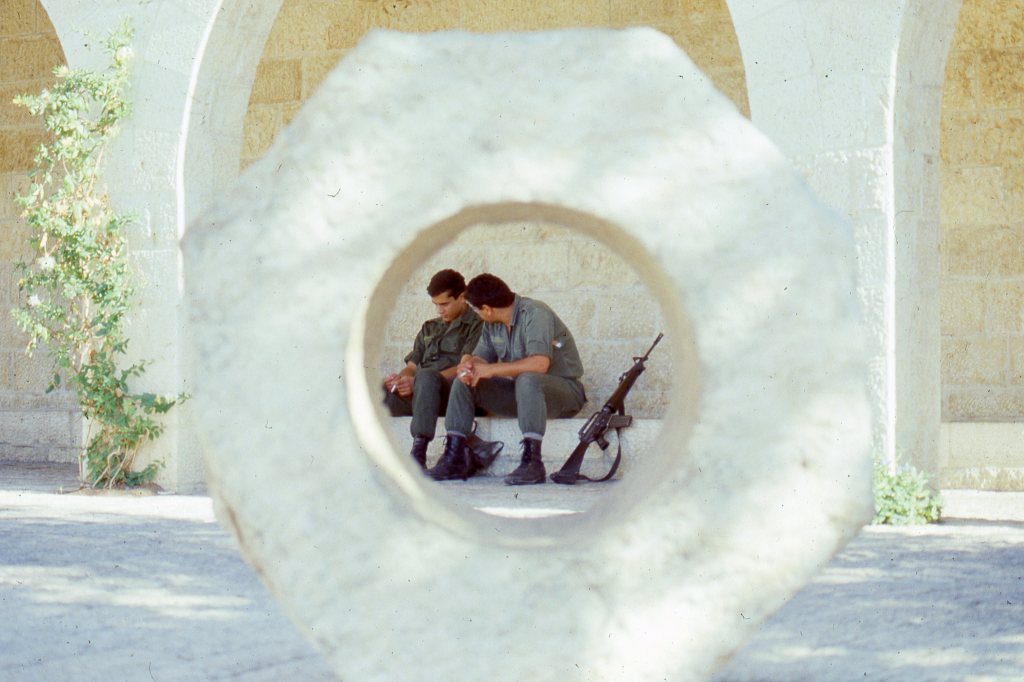
Israeli Defense Force soldiers take a break just west of the Temple Mount, Jerusalem. 1988. (C) Wil Robinson

A Song of Ascents. Of David.
Psalm 124

1 If it had not been the LORD who was on our side—
let Israel now say—
2 if it had not been the LORD who was on our side
when people rose up against us,
3 then they would have swallowed us up alive,
when their anger was kindled against us;
4 then the flood would have swept us away,
the torrent would have gone over us;
5 then over us would have gone
the raging waters.

6 Blessed be the LORD,
who has not given us
as prey to their teeth!
7 We have escaped like a bird
from the snare of the fowlers;
the snare is broken,
and we have escaped!

8 Our help is in the name of the LORD,
who made heaven and earth.

Psalm 124. In previous steps the ascending Levites have cried out for help, for mercy, for deliverance, as well as in praise. Here the Levites on the fifth step of ascent encourage all to exclaim confidently that our L-RD is for us; He is not against us despite the trials we may seen as we trod our paths.

“Besides applying this to any particular deliverance wrought in our days and the ancient times, we should have in our thoughts the great work of redemption by Jesus Christ, by which believers were rescued from Satan.” Matthew Henry.


L-RD Bless, Keep, Shine. . .

Song of Ascent: Fourth Step

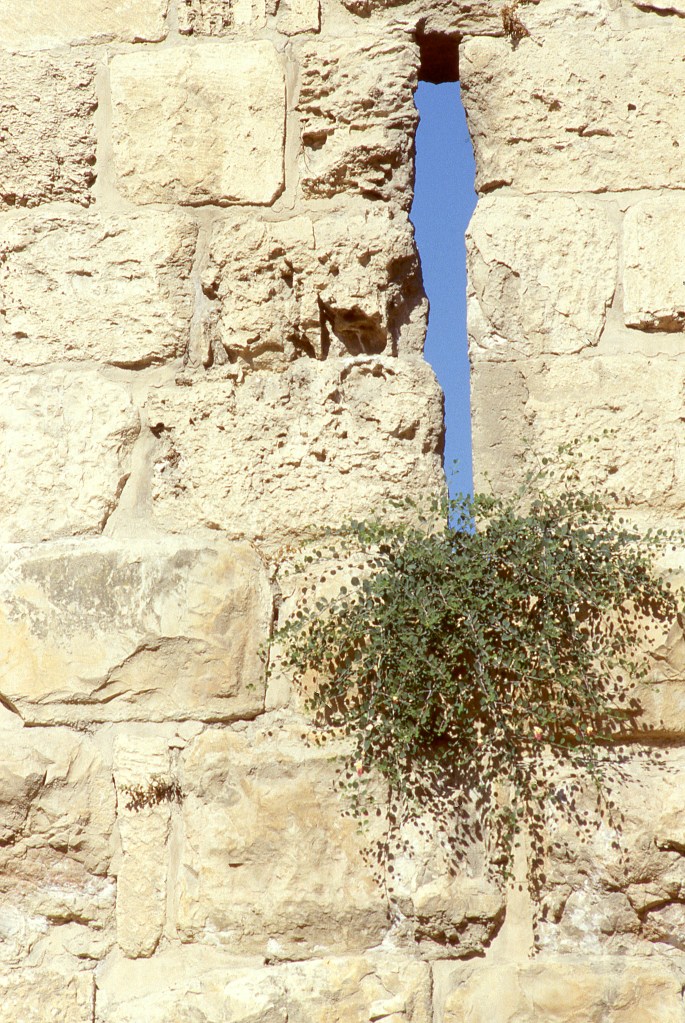
A portion of the Old City wall, Jerusalem. 1985 Wil Robinson

A Song of Ascents.
Psalm 123

1 To you I lift up my eyes,
O you who are enthroned in the heavens!
2 Behold, as the eyes of servants
look to the hand of their master,
as the eyes of a maidservant
to the hand of her mistress,
so our eyes look to the LORD our God,
till he has mercy upon us.

3 Have mercy upon us, O LORD, have mercy upon us,
for we have had more than enough of contempt.
4 Our soul has had more than enough
of the scorn of those who are at ease,
of the contempt of the proud.

Psalm 123, in “contrast of tone with the joy of the preceding psalm is very striking. After the heights of devout gladness have been reached, it is still needful to come down to stern realities of struggle, and these can only be faced when the eye of patient dependence and hope is fixed on God.” Expositor’s Bible Commentary

In Psalm 121 the Psalmist begins “I lift my eyes to the hills. . .” but ultimately we understand this isn’t where we receive our help. Here he simply begins plain and simple, “To you I lift up my eyes, O you who are enthroned in the heavens!” Wonderful!

I do like the way the Psalmist in verse four essentially says, “I’m so over the lazy and the arrogant.”


L-RD Bless, Keep, Shine. . .

Song of Ascent: Third Step

A Tribute to King David’s Harp. Outside the gate, near the Temple Mount. Jerusalem.

A Song of Ascents. Of David.
Psalm 122

1I was glad when they said to me,
“Let us go to the house of the LORD!”
2 Our feet have been standing
within your gates, O Jerusalem!

3 Jerusalem—built as a city
that is bound firmly together,
4 to which the tribes go up,
the tribes of the LORD,
as was decreed fora Israel,
to give thanks to the name of the LORD.
5 There thrones for judgment were set,
the thrones of the house of David.

6 Pray for the peace of Jerusalem!
“May they be secure who love you!
7 Peace be within your walls
and security within your towers!”
8 For my brothers and companions’ sake
I will say, “Peace be within you!”
9 For the sake of the house of the LORD our God,
I will seek your good.

Psalm 122, sung on the third step, and is described in Benson’s Commentary as “words of the people, exhorting one another to go and attend upon the worship of God at his tabernacle or temple at Jerusalem, and especially at the three great festivals;”

Forgotten are the complaints of the slanderous words by false witnesses cried out about on the first step. Forgotten are the fears of some undisclosed danger of which caused frantic eyes to look beyond the hills.

Now the Levites sing of the throngs who will come up to worship the G-D of Abraham, Isaac, and Jacob. The G-D of Moses and of King David. The G-D and Father of our L-RD Jesus. Our Father, our King.


L-RD Bless, Keep, Shine. . .

Song of Ascent: Second Step

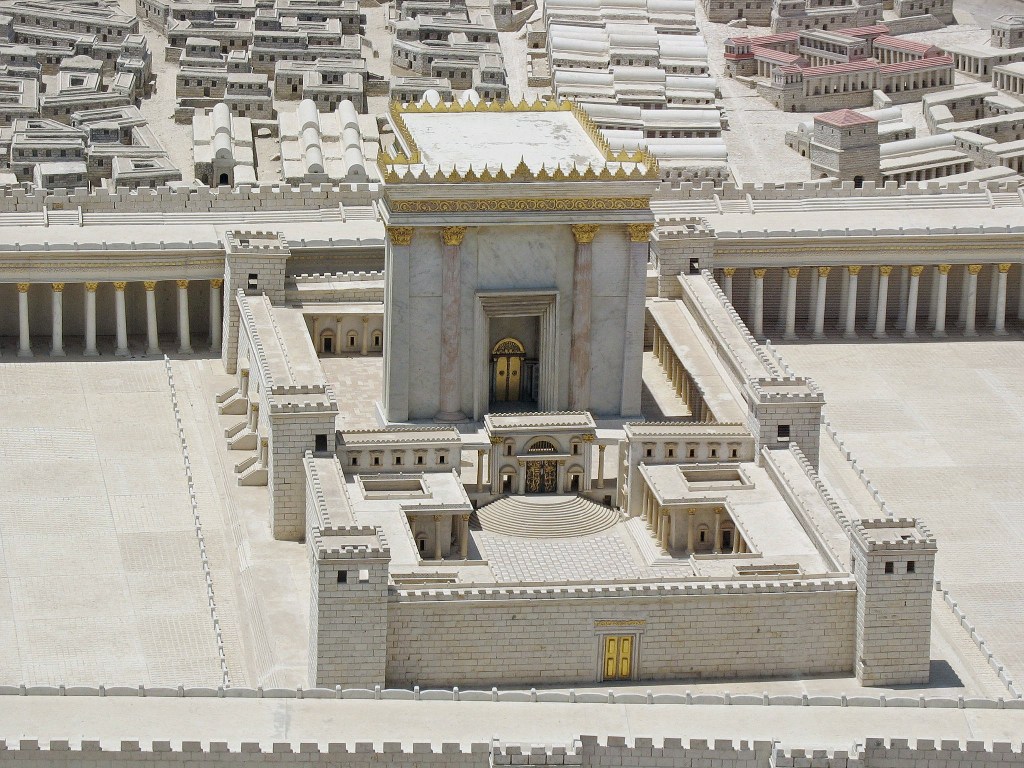
The Temple as it may have looked.

A Song of Ascents. Psalm 121

1I lift up my eyes to the hills.
From where does my help come?
2My help comes from the LORD,
who made heaven and earth.

3He will not let your foot be moved;
he who keeps you will not slumber.
4Behold, he who keeps Israel
will neither slumber nor sleep.

5The LORD is your keeper;
the LORD is your shade on your right hand.
6The sun shall not strike you by day,
nor the moon by night.

7The LORD will keep you from all evil;
he will keep your life.
8The LORD will keep
your going out and your coming in
from this time forth and forevermore.

On the second step, the Levites sang Psalm 121. It’s has always seemed to me that the first verse is best read as something like, “Even if I looked to the hills. . .” It is like a commander of soldiers who would greatly appreciate help in the heat and fog of battle. But there is neither help upon the hill nor any on the other side. And he knows it. He also knows from where his help will come.

The psalmist exclaims that “My help comes from the LORD,
who made heaven and earth.”

The psalmist, in verse five, shifts from a personal view to a more universal view of G-D and His Chosen. He proclaims, “The LORD is your keeper.” Here could be inserted Guardian, or certainly Shepherd. The word picture we might have is of our G-D standing watch over us.


L-RD Bless, Keep, Shine. . .

Song of Ascent: First Step

Narrow Ascent. Israel 1986 Photo by Wil Robinson

A Song of Ascents. Psalm 120

1In my distress I called to the LORD,
and he answered me.
2Deliver me, O LORD,
from lying lips,
from a deceitful tongue.

3What shall be given to you,
and what more shall be done to you,
you deceitful tongue?
4A warrior’s sharp arrows,
with glowing coals of the broom tree!

5Woe to me, that I sojourn in Meshech,
that I dwell among the tents of Kedar!
6Too long have I had my dwelling
among those who hate peace.
7I am for peace,
but when I speak, they are for war!

Psalm 120 is the first of fifteen psalms that all begin in a similar manner: A Song of Ascents. It is generally accepted among Jewish sages that these songs were sung by the Levites while ascending the steps separating the two sections of the courtyard outside the Temple. At each step one Psalm was sung, in order, until the last step and the last Psalm was sung.

The first verse sums up this song as a cry in distress and an answer. The trial that is causing this distress, according to Barnes’s Notes, is “caused by the tongue – slander.”


L-RD Bless, Keep, Shine. . .

A Song of Ascent

Psalm 127 is one of the Psalms that are called “A Song of Ascent.” There are fifteen of these Psalms, corresponding to the fifteen steps that the Levi ascended to the Temple. One Psalm, tradition states, is said on each step in the processional up to the Temple.

Unless the Lord builds a house,
its builders labor over it in vain;
unless the Lord watches over a city,
the watchman stays alert in vain.
In vain you get up early and stay up late,
working hard to have enough food —
yes, He gives sleep to the one He loves.
Sons are indeed a heritage from the Lord,
children, a reward.
Like arrows in the hand of a warrior
are the sons born in one’s youth.
Happy is the man who has filled his quiver with them.
Such men will never be put to shame
when they speak with their enemies at the city gate.

“A number of commentators explain this Psalm as a poem David composed upon being informed that his son Shelomo, rather than he, would be given the privilege of building the Bet Ha’mikdash. In the first two verses, David declares that it is God, not man, who determines when a building will arise. Regardless of how hard the laborers toil or how carefully the watchmen guard the building site, the project will materialize only with the direct assistance and support of the Almighty. David here accepts God’s decree forbidding him from building the Mikdash, recognizing that if God does not wish for him to build it then even if he would try the endeavor would assuredly fail.

“In the Psalm’s final verses (3-5), David turns his attention to the great blessing of children, whom he compares to “arrows in the hands of the mighty warrior” (verse 4). A warrior’s most valuable asset is effective weaponry; for a religiously conscientious Jew, the greatest commodity and blessing is children who follow the Torah traditions that he received from his parents. David thus expresses his gratitude for the fact that his son would perpetuate his legacy and heritage. Although he desired to personally oversee the building of the Mikdash, he found solace in the fact that he leaves behind a son faithful to his teachings, and who will fulfill Am Yisrael’s collective dream of having in their midst an abode for the Shechina (Divine Presence).” —Daily Tehillim

Matthew Henry comments: “Let us always look to God’s providence. In all the affairs and business of a family we must depend upon his blessing.
1. For raising a family. If God be not acknowledged, we have no reason to expect his blessing; and the best- laid plans fail, unless he crowns them with success.
2. For the safety of a family or a city. Except the Lord keep the city, the watchmen, though they neither slumber nor sleep, wake but in vain; mischief may break out, which even early discoveries may not be able to prevent.
3. For enriching a family. Some are so eager upon the world, that they are continually full of care, which makes their comforts bitter, and their lives a burden. All this is to get money; but all in vain, except God prosper them:while those who love the Lord, using due diligence in their lawful callings, and casting all their care upon him, have needful success, without uneasiness or vexation. Our care must be to keep ourselves in the love of God; then we may be easy, whether we have little or much of this world. But we must use the proper means very diligently.

“Children are God’s gifts, a heritage, and a reward; and are to be accounted blessings, and not burdens:he who sends mouths, will send meat, if we trust in him. They are a great support and defense to a family. Children who are young, may be directed aright to the mark, God’s glory, and the service of their generation; but when they are gone into the world, they are arrows out of the hand, it is too late to direct them then. But these arrows in the hand too often prove arrows in the heart, a grief to godly parents. Yet, if trained according to God’s word, they generally prove the best defense in declining years, remembering their obligations to their parents, and taking care of them in old age. All earthly comforts are uncertain, but the Lord will assuredly comfort and bless those who serve him; and those who seek the conversion of sinners, will find that their spiritual children are their joy and crown in the day of Jesus Christ.”

While there is some overlap in the thinking behind the commentaries, I also see a perspective that differs substantially. It illustrates my own thinking that Christianity has diverged from Judaism, going its own way, leaving behind a wealth of tradition AND a wealth of accompanied understanding. Judaism, on the other had, is stuck with tradition and its understanding. Without the Christian perspective of Y’shuaJesus as the Messiah, Judaism of today is doomed to simply wait. Judaism waits until G-d enables their minds to understand the Messiah Who came, Who is spoken of in Isaiah 53, is the suffering Messiah, is the same Messiah Christians have come to accept, and Who shall come again as the Conquering Messiah.

One Messiah. Two perspectives. Each perspective lacks something, however. Slowly this is changing for some people. Unfortunately it seems the “church” as a whole pulls away from Y’shuaJeus and His truth. As Psalm 127 points out, a building can not be built without G-d. And certainly the “church” tries in vain to build itself. Preachers gather pupils who listen to every word, but miss The Word, because the preachers so often preach from their own agenda, their own “gospel.”

Gentiles were allowed to have a taste of the Shechina, the Divine Presence, of G-d. But the Time of the Gentiles are coming to and end. The “church” has melted its gold and is forming a golden calve to worship. Soon, I believe, All the Shechina of our Lord with come to bear upon the Jewish people, and their eyes shall be opened that they might know Y’shuaJesus as Lord, as Messiah.

Numbers-6-24-26 - 1