reblog: WE NEED TO CALL OUT TO GOD’: FRANKLIN GRAHAM CALLS FOR A DAY OF FASTING, PRAYER AHEAD OF ELECTION — jesussocial

Evangelist Franklin Graham is urging Christians to partake in a day of fasting and prayer on Sunday, October 25, just 9 days before the 2020 Presidential election. Graham, who leads humanitarian aid organization Samaritan’s Purse and the Billy Graham Evangelistic Association, announced the event on social media. “I am urging followers of Jesus Christ to […]

WE NEED TO CALL OUT TO GOD’: FRANKLIN GRAHAM CALLS FOR A DAY OF FASTING, PRAYER AHEAD OF ELECTION — jesussocial

If I forget you, O Jerusalem, let my right hand forget its skill!

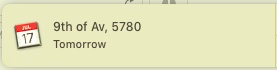
9thAv
Begins tonight at sunset

By the waters of Babylon, there we sat down and wept, when we remembered Zion. 

On the willows there we hung up our lyres.

For there our captors required of us songs,
and our tormentors, mirth, saying,

Sing us one of the songs of Zion!”

How shall we sing the L-RD’s song in a foreign land?

If I forget you, O Jerusalem, let my right hand forget its skill!

Let my tongue stick to the roof of my mouth,
if I do not remember you,
if I do not set Jerusalem above my highest joy!

(Psalm 137:1-6)


Saturday Night Begins Tisha B’Av

Saturday evening begins the ninth day of the fifth month in the Jewish calendar, which is “Tisha B’Av, the Fast of the Ninth of Av, is a day of mourning to commemorate the many tragedies that have befallen the Jewish people, many of which have occurred on the ninth of Av,” according to Judaism 101.

3“Tisha B’Av primarily commemorates the destruction of the first and second Temples, both of which were destroyed on the ninth of Av (the first by the Babylonians in 586 B.C.E.; the second by the Romans in 70 C.E.).

“Although this holiday is primarily meant to commemorate the destruction of the Temple, it is appropriate to consider on this day the many other tragedies of the Jewish people, many of which occurred on this day, most notably the expulsion of the Jews from Spain in 1492 and from England in 1290.” —Judaism 101

There is another tradgedy that concerns the ninth of Av. “The year is 1313 BCE. The Israelites are in the desert, recently having experienced the miraculous Exodus, and are now poised to enter the Promised Land. But first they dispatch a reconnaissance mission to assist in formulating a prudent battle strategy. The spies return on the eighth day of Avand report that the land is unconquerable. That night, the 9th of Av, the people cry. They insist that they’d rather go back to Egypt than be slaughtered by the Canaanites. G‑d is highly displeased by this public demonstration of distrust in His power, and consequently that generation of Israelites never enters the Holy Land. Only their children have that privilege, after wandering in the desert for another 38 years. — Chabad.org

Those things happened a long time ago. More recently,”World War II and the Holocaust, historians conclude, was actually the long drawn-out conclusion of World War I that began in 1914. And yes, amazingly enough, Germany declared war on Russia, effectively catapulting the First World War into motion, on the 9th of Av, Tisha b’Av.” — Chabad.org

So, how long must we remember things of the past? As long as it takes that they are not repeated.

Chabad.org put it this way: “What do you make of all this? Jews see this as another confirmation of the deeply held conviction that history isn’t haphazard; events—even terrible ones—are part of a Divine plan and have spiritual meaning. The message of time is that everything has a rational purpose, even though we don’t understand it.”

Numbers-6-24-26 - 1

Yom Kippur

Pictured here is the Western Wall--one of the ...
Pictured here is the Western Wall–one of the most sacred sites in Judaism. On the Jewish holiday Yom Kippur, hundreds of thousands of Jews flock to the site, praying and seeking atonement for their sins. Yom Kippur, the Day of Atonement, is the holiest day on the Jewish calendar. On the Yom Kippur of October 6, 1973, Egypt and Syria launched a coordinated surprise attack on Israel. Photo: IDF photo archives. (Photo credit: Wikipedia)

If you were to enter a synagogue today, Chabad.org has a guide to what to expect. It includes: “You may also notice that many people are wearing white clothing, and some are even wearing a white robe called a kittel. This is because on Yom Kippur we are likened to angels. The angels do not eat, and neither do we. The angels devote themselves to praising G‑d, and so do we. The shroud-like kittel also reminds us that all life on earth comes to an end.”

Yom Kippur is the Day of Atonement. It’s history and significance is as follows (also from chabad.org):

“Forty days after they received the Torah at Mount Sinai and committed to be G‑d’s chosen people, the Children of Israel worshipped a Golden Calf. Moses pleaded with G‑d not to destroy His errant nation, and on the tenth of Tishrei G‑d said, “I have forgiven.” Ever since, we observe this date as the “Day of Atonement”—a celebration of our indestructible relationship with G‑d. It is the holiest day of the year, when we reconnect with our very essence, which remains faithful to G‑d regardless of our behavior.

“Yom Kippur is a fast day: from sundown on the eve of Yom Kippur until the following nightfall, we do not eat or drink. We also abstain from certain physical pleasures: wearing leather footwear, bathing or washing, applying lotions or creams, and marital relations. It is also a “day of rest,” on which all work is forbidden (as on Shabbat).

“The greater part of the day in the synagogue we engage in repentance and prayer. There are five prayer services: 1) The evening prayers, which begin with the solemn Kol Nidrei. 2) Morning prayer. 3) Musaf, which includes a description of the Yom Kippur Holy Temple service. 4) Afternoon prayer, during which the Book of Jonah is read. 5) Ne’ilah, recited as the day wanes and the verdict for the new year is sealed. The first four prayers include a (private) confession of sins to G‑d. Ne’ilah concludes with the congregation calling out the Shema in unison, and then a blast of the shofar signals the end of the day.

“Yom Kippur is followed by a festive meal. We rejoice, confident that G‑d has forgiven our sins.”

The author of the “New Testament” letter to the Hebrews wrote about the yearly sacrifice offered at the Temple to atone for the sins of the People of G-d.

For since the law has but a shadow of the good things to come instead of the true form of these realities, it can never, by the same sacrifices that are continually offered every year, make perfect those who draw near. Otherwise, would they not have ceased to be offered, since the worshipers, having once been cleansed, would no longer have any consciousness of sins? But in these sacrifices there is a reminder of sins every year. For it is impossible for the blood of bulls and goats to take away sins. Consequently, when Christ came into the world, he said, “Sacrifices and offerings you have not desired, but a body have you prepared for me; in burnt offerings and sin offerings you have taken no pleasure. Then I said, ‘Behold, I have come to do your will, O God, as it is written of me in the scroll of the book.'” When he said above, “You have neither desired nor taken pleasure in sacrifices and offerings and burnt offerings and sin offerings” (these are offered according to the law), then he added, “Behold, I have come to do your will.” He does away with the first in order to establish the second. And by that will we have been sanctified through the offering of the body of Jesus Christ once for all.

And every priest stands daily at his service, offering repeatedly the same sacrifices, which can never take away sins. But when Christ had offered for all time a single sacrifice for sins, he sat down at the right hand of God, waiting from that time until his enemies should be made a footstool for his feet. For by a single offering he has perfected for all time those who are being sanctified. And the Holy Spirit also bears witness to us; for after saying, “This is the covenant that I will make with them after those days, declares the Lord: I will put my laws on their hearts, and write them on their minds,” then he adds, “I will remember their sins and their lawless deeds no more.” Where there is forgiveness of these, there is no longer any offering for sin. Therefore, brothers, since we have confidence to enter the holy places by the blood of Jesus, by the new and living way that he opened for us through the curtain, that is, through his flesh, and since we have a great priest over the house of God, let us draw near with a true heart in full assurance of faith, with our hearts sprinkled clean from an evil conscience and our bodies washed with pure water.

Hebrews 10:1-22

Lord Bless, Keep, Shine. . .

Hadassah

“And when Haman saw that Mordecai did not bow down or pay homage to him, Haman was filled with fury.Purim

“But he disdained to lay hands on Mordecai alone. So, as they had made known to him the people of Mordecai, Haman sought to destroy all the Jews, the people of Mordecai, throughout the whole kingdom of Ahasuerus.” Esther 3:5-6

Matthew Henry Comments on Esther 3:4
“Mordecai refused to reverence Haman. The religion of a Jew forbade him to give honours to any mortal man which savoured of idolatry, especially to so wicked a man as Haman. By nature all are idolaters; self is our favourite idol, we are pleased to be treated as if every thing were at our disposal. Though religion by no means destroys good manners, but teaches us to render honour to whom honour is due, yet by a citizen of Zion, not only in his heart, but in his eyes, such a vile person as Haman was, is contemned, Psalms 15:4. The true believer cannot obey edicts, or conform to fashions, which break the law of God. He must obey God rather than man, and leave the consequences to him. Haman was full of wrath. His device was inspired by that wicked spirit, who has been a murderer from the beginning; whose enmity to Christ and his church, governs all his children.”

As we approach the Feast of Purim, I have Hadassah on my mind. As with all scripture, if we take the time, if we seek the leading of the Spirit of G-d, we shall gain much. As the Apostle Paul wrote:

“. . .the sacred writings which are able to give you the wisdom that leads to salvation through faith which is in Christ Jesus. All Scripture is inspired by God and profitable for teaching, for reproof, for correction, for training in righteousness; so that the man of God may be adequate, equipped for every good work.” 2 Timothy 3:15-17.

Now Hadassah and Mordecai lived during the Exile between 483BC and 471BC. They, as all Jews in exile, were unable to worship in the Temple. They began to gather together for teaching, prayer, and mutual encouragement. As we see in the Book of Esther, G-d makes a way for His people to assemble if we really want to learn about Him, praise Him, worship Him, and grow in His Ways.

Let’s think about that, and return together Wednesday.

Lord Bless, Keep, Shine. . .

A Little Dose of Prevention

“But this kind does not go out except by prayer and fasting.”
(Matthew 17:21 MRC)

The expression is usually “an ounce of prevention is worth a pound of cure,” but given current emphasis across Europe and America for flu shots, the word dose comes to mind. In Matthew’s Gospel we are told of disciples who didn’t have the dose of prevention and left Y’shuaJesus having to apply a pound of cure. Y’shua cured a man’s son. When the disciples asked Y’shua why they couldn’t cast out the demon, Y’shua explained that they didn’t have the faith to do so.

Matthew Henry, in his commentary, wrote: “If ye have ever so little of this faith in sincerity, if ye truly rely upon the powers committed to you, ye shall say to this mountain, Remove. This is a proverbial expression, denoting that which follows, and no more, Nothing shall be impossible to you. They had a full commission, among other things, to cast out devils without exception; but, this devil being more than ordinarily malicious and inveterate, they distrusted the power they had received, and so failed. To convince them of this, Christ shows them what they might have done. Note, An active faith can remove mountains, not of itself, but in the virtue of a divine power engaged by a divine promise, both which faith fastens upon.”

After explaining the disciples’ lack of faith, He goes on to say the “this kind [of demon] does not go out except by prayer and fasting.” The implication here is this: The disciples must couple a trust in the power they had received with previous prayer and fasting. The disciples not only didn’t have the faith necessary to cast out the demon, they weren’t prepared to do so either.

Point One. Preparation is required for our readiness. This preparation is required for more than the casting out of demons, as Peter wrote: “. . . sanctify Messiah as Lord in your hearts. Always be prepared to make a defense to everyone who asks you to give a word for the hope that is in you, but with gentleness and fear for God.” (1 Peter 3:15 MRC) We are to be prepared to make a defense.

When I think of being prepared, I think of Stephen: “Then some from what is called the Freedmen’s Synagogue, composed of both Cyrenians and Alexandrians, and some from Cilicia and Asia, came forward and disputed with Stephen.” (Acts 6:9 HCSB). Before Stephen died, he witnessed to those who stoned him. Stephen was prepared for any and all events.

Point Two. Prayer is a key component of preparation. Prayer is, in a general sense, the act of asking for a favor, and particularly with earnestness. In worship, prayer is a solemn address to G-d, consisting of adoration, or an expression of our sense of G-d’s glorious perfections, confession of our sins, supplication for mercy and forgiveness, intercession for blessings on others, and thanksgiving, or an expression of gratitude to God for his mercies and benefits.

But I like a more simple definition. It is being with G-d, through our acceptance of Messiah Y’shua, and the indwelling of the Holy Spirit. It is being like Adam, and walking with G-d in the Garden.

Point Three. Fasting is another key component of preparation. How shall we fast? The Lord tells us through the prophet Isaiah: “Isn’t the fast I choose: To break the chains of wickedness, to untie the ropes of the yoke, to set the oppressed free, and to tear off every yoke? Is it not to share your bread with the hungry, to bring the poor and homeless into your house, to clothe the naked when you see him, and to not ignore your own flesh and blood? Then your light will appear like the dawn, and your recovery will come quickly. Your righteousness will go before you, and the LORD’s glory will be your rear guard.” (Isaiah 58:6-8 HCSB)

Simply put, fasting is denying our fleshly nature, our self-centered approach to life, and obeying the Holy Spirit.
May the Lord enable us to meet the requirements of each day, having mercy upon us.

Lord Bless, Keep, Shine. . .