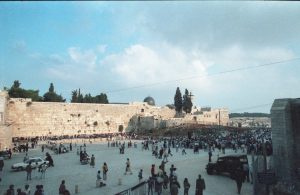
The Western Wall, above which once stood The Temple, destroyed twice each time on this day of great sorrow. Photo by wil robinson 1986
How lonely sits the city that was full of people!
How like a widow has she become,
she who was great among the nations!
She who was a princess among the provinces
has become a slave.
She weeps bitterly in the night,
with tears on her cheeks;
among all her lovers
she has none to comfort her;
all her friends have dealt treacherously with her;
they have become her enemies.
We were buried with Messiah; we also rose with Messiah. Should I continue with my head buried in the sand, not paying attention to this mortal world that has me surrounded? I pose this question to myself, really. It is easy for me to ignore all that is going on about me. I read some blogs and I find myself irritated the writers speak about loving the Christian Brethren as well as loving those we don’t like. It’s clearly a way to, I said, to jump on the bandwagon of the current American protest movement and its offshoot of violence and destruction. Some bloggers are more open about their views in support of, or denouncing, this uprising. Others veil there comments in generalities and mere illusions. I’ve not been sure which is worse, actually.
Then I found myself applauding blogs that mention the things that are going on, this outcry for “justice,” but not taking sides. Christians are commanded, I thought, to step above politics and temporal concerns to focus on the message of the Gospel as the solution to the failures of humankind. For those who cry out for “justice” have no clue what they are asking. Can the ungodly, the sinner, desire justice? Justice when delivered means a condemnation of sin. Rather than asking for justice, should we not all recognize our failures, or sins, and turn to our Creator seeking His Mercy and love? The hope for America, the hope for the world, is Jesus. This is the message of the Gospel; this is the hope for humanity.
And what of this generation of protesters that seem to want to tear down that which has been established? They seem to think they have a solution. Symbolically, this tearing down is carried out in things like removing statues, eradicating history, as if this will right the wrongs of the past. It’s been said that forgeting the pats means doing it all over agian.
Those who protest are not the first to open their mouths and fists, however. Born in the end of the 1940s, I grew up in one of the great revolutions—The American Sixties. We wanted to tear down the establishment. We didn’t—at lest most of us—have a clue what we wanted to build on its ashes. Sure, a few visionaries with ideas cropped up here ant there. Some of them went on to join the establishment themselves, making their mark on our culture, and in many cases soiling it with their excrement. Most just joined back in and lived out their lives like those generations who came before.
I expect nothing less of these current protesters. Raised fists fall. Palms once clutched tightly must open. Resignation sets in when understanding comes. There is nothing new under the sun. What has been done in the past is done again over and over. Footprints in the sand are swept away in the tidal movement of time.
“The end of the matter; all has been heard. Fear G-d and keep His commandments, for this is the whole duty of man. For G-d will bring every deed into judgment, with every secret thing, whether good or evil.” (Ecclesiastes 12:13,14)
Here’s something I posted in 2013, which I thought about after reading Pastor Wild’s post. I share it again here:
“What the World Needs Now Is Love” is a 1965 popular song with lyrics by Hal David and music composed by Burt Bacharach. First recorded and made popular by Jackie DeShannon, it was released on April 15, 1965, on the Imperial label after a release on sister label Liberty records the previous month was canceled. The song reached number 7 on the US charts in May of that year. (source: Wikipedea)
Twenty-eight years ago today, Jackie DeShannon released the song that cried out a prayer for love.
Lord, we don’t need another mountain
There are mountains and hillsides enough to climb
There are oceans and rivers enough to cross
Enough to last ’til the end of time
What the world needs now is love, sweet love
It’s the only thing that there’s just too little of
What the world needs now is love, sweet love
No, not just for some, oh, but just for every, every, everyone
While true for today as for the sixties, the call for love didn’t begin with Jakie DeShannon’s song. G-d commanded love, way back when:
“. . .you shall love your neighbor as yourself: I am the LORD.” (Lev 19:18)
The Apostle Paul wrote quite a bit about love. Here are some sample quotes:
“Let love be genuine. Abhor what is evil; hold fast to what is good.” (Romans 12:9)
“Love one another with brotherly affection. Outdo one another in showing honor.” (Romans 12:10)
“Owe no one anything, except to love each other, for the one who loves another has fulfilled the law.”
(Romans 13:8)
“For the commandments, “You shall not commit adultery, You shall not murder, You shall not steal, You shall not covet,” and any other commandment, are summed up in this word: “You shall love your neighbor as yourself.”
(Romans 13:9)
“Love does no wrong to a neighbor; therefore love is the fulfilling of the law.” (Romans 13:10)
Isn’t it love that will counter lawlessness? Isn’t love that will bring peace and happiness? Perhaps. But before we can have love, before we can have peace, before we can have happiness, we must:
“. . .seek first the kingdom of God and his righteousness, and all these things will be added to you.”
(Matthew 6:33)
Perhaps that’s the problem. We want love, we want peace, we want happiness, but we don’t seek the Lord while He can be found.
Today I am reposting “Peace On Earth,” which was written and posted four years ago.
There’s a scene from some movie that just popped itself into my mind. There’s an angry man spouting off about something, and another man says to him, “Ah, does someone need a hug?” Anger isn’t exactly an emotion; rather it attempts to cover an emotion. And a hug from “Mom” can go a long way to rid one of anger, expose the underlying emotion, and sooth it. Unless, that is, that a person has a problem with Mom. Dr. Sigmund Freud was hung up on “Mom” and sex, and peoples Oedipus-like desires to have sex with their moms and kill there fathers. He thought that while we were still babies our fantasies centered around having Mom all to our selves and not letting Dad near her. It didn’t work too well, and some people never got over it all. They grow up to find other ways to get even with their moms and dads.
So with 300 million people living in America and a social media that puts everyone in everyone else’s face all the time, feathers are going to be ruffled as we play out our Oedipus fantasies on each other. People have their underlying emotions stirred, that then surge, and the result is that angry words spew forth. People discover there are other people that feel the same way, and they gather together to protest someone they feel has offended them. Lately it’s been presidential candidates who’ve modeled the use of verbal assault weapons, and become the object of protests. Conflict. And the television/internet media gets to watch, film, and report all of it to an eager audience, perpetuating the cycle of conflict.
Why can’t people just get along? Why isn’t there peace on Earth?
Do not think that I have come to bring peace to the earth. I have not come to bring peace, but a sword. [Jesus said]
— Matthew 10:34
Why? Why does it seem there needs to be conflict? In a writing class, I was once instructed on the use of conflict and resolution. In a story the author allows conflict to drive the story along. building a certain tension. At some point the author must allow the reader to feel resolution, too. There must be some form of resolution after conflict has built or the reader will feel let down.
Just as conflict drive an author’s story, so does it drive our lives. But conflict is only useful if we are able to find a resolution to the conflict. A solution. An answer. Conflict drives us to look for answers.
On the back of a Jeep was a bumper sticker that summed this issue up well. It read:
In Apostle Paul’s first letter to the Thessalonians—2:3,4—Paul writes about the Great Day of the L-RD and how it doesn’t happen until “the rebellion comes first, and the man of lawlessness is revealed, the son of destruction, who opposes and exalts himself against every so-called god or object of worship, so that he takes his seat in the temple of God, proclaiming himself to be God.”
Looking at Barnes’s Notes. He makes the following comment concerning the Temple of G-D:
“Sitteth in the temple of God – That is, in the Christian church. It is by no means necessary to understand this of the temple at Jerusalem, which was standing at the time this Epistle was written, because: the phrase “the temple of God” is several times used with reference to the Christian church, 1 Corinthians 3:16, 1 Corinthians 3:17; 2 Corinthians 6:16; Ephesians 2:21; Revelation 3:12; and, . . When the Christian church was founded, it was spoken of as the peculiar dwelling-place of God.”
The Christian Church, according to Pastor Barnes, is the Temple of G-D. I wondered about this.
Jesus did refer to His body as the Temple. “What sign do you show us for doing these things?” Jesus answered them, “Destroy this temple, and in three days I will raise it up.” The Jews then said, “It has taken forty-six years to build this temple,c and will you raise it up in three days?” But he was speaking about the temple of his body. (John 2:18-21)
The references cited by Pastor Barnes refer to the individual Christian, the Christian’s body, as being the Temple of G-D, or the Temple of the Holy Spirit. Is the Pastor wrong? What am I missing?
The Christian Church—the True Church of Christ—isn’t a religious institution, it isn’t a specific place or building. The Christian Church is considered the Body of Christ on Earth, which is made up of all Believers in Christ. In this regard, the Church is the Temple of G-D. Pastor Barnes has a point. The Christian Church is the Temple of G-D on Earth.
When we think of this man of lawlessness of whom Apostle Paul speaks, we think antichrist. When we think about the Temple that will be desecrated by this antichrist we think about a reconstructed Temple in Jerusalem, on the site of two former Temples.
When Pastor Barnes thinks about the Temple he thinks about the Church. He says of the antichrist that he is “claiming in the Church of Christ the authority and homage which God had in the temple at Jerusalem.” Pastor Barnes also dispels the thought that the antichrist must actual say he is G-D. He puts it this way, “Showing himself that he is God – This does not necessarily mean that he actually, in so many words, claimed to be God; but that he usurped the place of God, and claimed the prerogatives of God.”
Rather, then, than a man who stands in a building proclaiming himself to be god, could we understand this as a way of thinking that affects our heart? Think about “authority and homage” in relation to us as individual believers. What have I allowed to hold authority over my life? To what do I give homage that is due only to the Father of our L-RD Jesus? Do I revere and submit to people or institutions or even ideas in any way above or even equal to our G-D? Those would be gods. Idols. Could the views and ideas of politicians, scientists, philosophers, public health authorities, hold sway over me above that of G-D? If they don’t now, could they in the future?
And G-D spoke all these words, saying, “I am the L-RD your God, who brought you out of the land of Egypt, out of the house of slavery. You shall have no other gods before me. You shall not make for yourself a carved image, or any likeness of anything that is in heaven above, or that is in the earth beneath, or that is in the water under the earth. You shall not bow down to them or serve them, for I the L-RD your God am a jealous God, visiting the iniquity of the fathers on the children to the third and the fourth generation of those who hate me, 6but showing steadfast love to thousands of those who love me and keep my commandments. (Exodus 20:1-5 The First Commandment)
As one blogger pointed out, last year when a person sneezed, “god bless you” was a common response. No longer is a sneeze okay. But the question is: When a person says, “god bless you,” of whom is that person speaking?
“Lord help us!” a person might say. Which lord. How about lord krishna, of India?
Some Bibles help us in this way: LORD used in all caps refers to the Name of the God of Israel.
In Psalm 20, in the first verse, King David identifies G-d, of Whom he speaks as he requests assistance on our behalf, as the God of Jacob. Fairly specific, without using an actural name, however.
In Psalm 91, verse 14, the G-d of Israel says: “I will protect them because they know My Name.”
Do you know the Name of the G-d of Israel?
I pray on behalf of those who know the Name of the Master of the Universe, the God of Jacob:
1May the L-RD answer you in the day of trouble! May the name of the G-d of Jacob protect you! 2May he send you help from the sanctuary and give you support from Zion! 3May he remember all your offerings and regard with favor your burnt sacrifices! Selah
4May he grant you your heart’s desire and fulfill all your plans! 5May we shout for joy over your salvation, and in the name of our G-d set up our banners! May the L-RD fulfill all your petitions!
6Now I know that the L-RD saves his anointed; he will answer him from his holy heaven with the saving might of his right hand. 7Some trust in chariots and some in horses, but we trust in the name of the LORD our God. 8They collapse and fall, but we rise and stand upright.
9O L-RD, save the king! May he answer us when we call.
Psalm 20
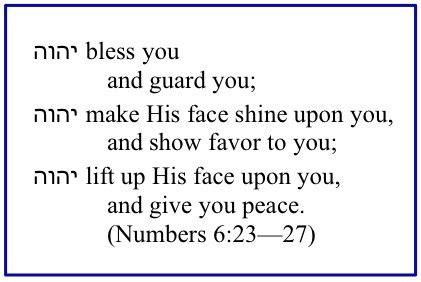
The L-RD bless you and protect you!
The L-RD deal kindly and graciously with you!
The L-RD bestow His favor upon you and grant you peace!
This afternoon I sat on the back deck. I listened to part of Billy Graham’s sermon given in 1981 at a “Campaign” in Calgary. He spoke about Jonah and how G-d gave him a second chance. He also said that sometimes there just isn’t another opportunity. Take it or leave it. He used the example of one of the thieves on a cross beside Jesus. That man choose to accept Jesus. There would never be another opportunity to do so. I was good preaching! Old time preaching.
I thought about my second chance. I am so grateful to G-D for His persistent calling. Growing up in the church, I may have thought I was okay. The year was early 1962. I was in 8th grade, and my first chance came. I was at Brown Military Academy. I had a wonderful “religion” teacher, Mr. Kitchen. One weekend, along with many of my classmates, he took us to a Christian youth retreat. As I’ve reflected on Mr. Kitchen’s faith, I’m sure he was evangelical, maybe Pentecostal evangelical. The camp was great. The preaching was a lot different from the Episcopal church sermons. I was drawn in. On Sunday toward the close of the camp, there was a final sermon.
I remember not one word of what was said during the evangelistic sermon. What I remember, as if it was today–what I can picture in my min–is the alter call. It is so vivid: the preacher saying to close our eyes. I closing my eyes. Then he asked for a show of hands. I remember wanting raise my had, but didn’t. I peaked to see others. Then the preacher called for those with hands raised to come forward. I wanted to go, but didn’t. I peaked to see others go.
In Billy Graham’s sermon, he said some of the words that were probably from a song. They were about looking back and remembering a time when we’d been called and not responded. About how we might long to be able to go back to that time and respond.
How many times, I can’t count, have I said, “if only.” If I’d not walked but run to that alter that very moment, how my life might have change then, and not have waited and wandered aimlessly so may years. But I can’t relive those moments so long ago.
My second chance came, and Spirit of G-D enabled me to embrace it. I can’t go back to the first chance. So I move forward. For past is forgiven, forgotten. Today is nearly over. There’s a new day tomorrow to live, not try to relive the past. It’s a new day to make good choices, make good moves. Or at least better ones. May our Heavenly Father work His way in and through me in those choices, in those moves.
“. . .events surrounding the coronavirus have demonstrated how quickly the status quo can be overturned, how dramatically the fortunes of nations can shift, and how a call for one-world cooperation can arise,” wrote Brown. “And what if there was a worldwide economic collapse, accompanied by plague and famine? Is it too farfetched to imagine that a powerful, problem solving leader could gain an international following?”
Brown points out that Jesus answered His disciples’ questions about His return, as reported by Matthew (chapter 24):
“See that no one leads you astray.For many will come in my name, saying, ‘I am the Christ,’ and they will lead many astray.And you will hear of wars and rumors of wars. See that you are not alarmed, for this must take place, but the end is not yet.”
In the article, Brown explains at least two potential candidates for antichrist in our times: The muslim mahdi and a messiah of the ultra-orthodoxy in Israel. It’s fascinating reading.
But Brown also stresses that “To say it again, I do not believe we are at that point. But I do believe that, in front of our eyes, we’re seeing how quickly the table can be set, even from an entirely secular point of view.”
Brown isn’t pointing to either the Iranian or the Israeli messiah as the antichrist.
I think they are examples of how easily the world can be decieved, especially in a time in which there is so much fear, desire for a remedy, desire for some form of normalicy in our lives and our world.
“But all this talk about the Mahdi being here, ready to be revealed, along with the traditional Jewish Messiah being here, ready to be revealed, underscores the point I have been making. It would not take much for a counterfeit Messianic figure to arise and deceive many,” Brown wrote. “Let us, then, keep our focus on the Second Coming of the true Christ (= Messiah). But let us not forget the warnings about that false Messiah (= antichrist) who will come first,” Brown concludes.
We must, as Yeshua said, “See that no one leads you astray.” We must see that no one leads us astray. No one. We must look into the eyes of our L-RD, that the things of the world grow dim in His light.
“Recognizing and giving praise to God does not depend on geographic location; wherever a person is, he can and must serve his Creator with the resources to which he has access under his current circumstances.” —Daily Tehillim in its commentary on Psalm 98. (emphasis added)
In Psalm 98, the entire world, all nations, are shown giving praise and thanksgiving to our Heavenly Father. This Psalm has its fulfillment in the Messianic Era. We, as Believers in Yeshua Jesus as Messiah, understand this to be after Yeshua Jesus returns to Earth. It is a time in which the final glorification of our bodies will take place.
And yet, even in our mortal bodies, even now on Earth, we can give praise to Father, Yeshua, and Spirit.
It stikes me today, as I read this psalm, that we may not be doing the things we might normally do, going the places we normally go, meeting the people we might normally meet. But I take heart in what the commentary for Psalm 98 says, “wherever a person is, he can and must serve his Creator with the resources to which he has access under his current circumstances.”
Thank You, Yeshua, for the assurance of Your salvation that You provided for those You call Your own. As we hunker down during these days of pandemic, under these current circumstances, draw us close to You, that we may give You glory, honor, and praise. Amein.


 We were buried with Messiah; we also rose with Messiah. Should I continue with my head buried in the sand, not paying attention to this mortal world that has me surrounded? I pose this question to myself, really. It is easy for me to ignore all that is going on about me. I read some blogs and I find myself irritated the writers speak about loving the Christian Brethren as well as loving those we don’t like. It’s clearly a way to, I said, to jump on the bandwagon of the current American protest movement and its offshoot of violence and destruction. Some bloggers are more open about their views in support of, or denouncing, this uprising. Others veil there comments in generalities and mere illusions. I’ve not been sure which is worse, actually.




 Jonah’s Song