
Occasionally, looking into the eyes of my daughter’s dog, I will joke with my daughter about what that dog is thinking. Do animals think? I’ve heard that thinking is what differentiates animals from humans. At one time didn’t people think it was communication—talking—that separated us from animals? Huh. My daughter’s cat talks. Well, okay, not in English. Cat talk, I guess. She has a particular way of saying, “Eeyowaaaah” when it’s around the time of day she is feed. When she decides she wants attention, she says, “Eeh,” while rubbing against my leg. And the other day, at the laundry room door, she said, “Eeyo.” It wasn’t feeding time. She wasn’t near by to want her head scratched. What does “Eeyo” mean.
Tag: Praise
The Staff of G-d, the Sword of Joshua
Then Amalek came and fought with Israel at Rephidim. So Moses said to Joshua, “Choose for us men, and go out and fight with Amalek. Tomorrow I will stand on the top of the hill with the staff of God in my hand.” So Joshua did as Moses told him, and fought with Amalek, while Moses, Aaron, and Hur went up to the top of the hill. Whenever Moses held up his hand, Israel prevailed, and whenever he lowered his hand, Amalek prevailed. But Moses’s hands grew weary, so they took a stone and put it under him, and he sat on it, while Aaron and Hur held up his hands, one on one side, and the other on the other side. So his hands were steady until the going down of the sun. And Joshua overwhelmed Amalek and his people with the sword.
—Exodus 17:8-13
It makes sense that Moses should stand upon a hill, above the battle, with upheld arms. The symbolism seems clear. Moses raising his arms, yielding to the will of G-d, his own strength wanes. Aaron and Hur support Moses, allowing him to continue to hold high the staff of G-d. The staff symbolizes authority. It is upon G-d’s authority that Moses sends Josua and the people of G-d into battle. Somewhere I read that the names Aaron and Hur meant Praise and Word. This, too, makes sense. For holding up the arms of Moses, supporting the waning strength is:
Praise of G-d
Word of G-d
But let us not deceive ourselves into thinking that all it takes to gain victory over an enemy is to stand upon the authority of G-d, holding up the Word of G-d as our justification, lifting our hands, our arms in praise. For there, below Moses, boots hit the ground, weapons found their mark. The people of G-d fought for liberty from their enemy, an enemy that would enslave them.
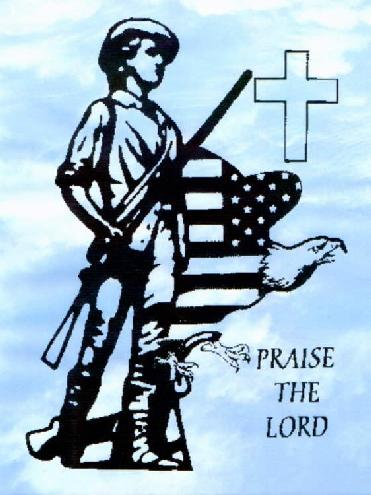 And some 3,000 years later—two-hundred and forty years ago—farmers on what is now American soil stood together against another form of enslavement: British imperial tyranny. They stood together for Liberty. They stood together for Justice. And so it began in Lexington, not far from Boston, that well-trained British soldiers were ordered to move against the colonial people, against farmers and craftsmen. They were ordered to subdue men and women, untrained in the art of war. But the colonist stood bravely against the “red coats.’ Ordered to give up their arms, they refused. Shots were fired. Shooting continued into their backs as they ran. Men died, including their commander. This was the battle, really a massacre, of Lexington. But. . .
. . .came Concord. On April 19th, 1775, things would be different. It began a mile out of Concord, at Meriam’s Corner, as the red coats crossed a bridge, still exuberant from their victory and sacking of Lexington. They marched toward Boston. They met more untrained farmers and craftsmen. But this time, the red coats faced a different tactic, one we call guerrilla warfare.
“By the rude bridge that arched the flood
Their flag to April’s breeze unfurled,
Here once the embattled farmers stood
And fired the shot heard round the world.”
—Ralph Waldo Emerson
“Even now, the significance of Lexington and Concord awakens a response in Americans that goes far beyond the details of the day or the identity of the foe. An unmilitary people, at first overrun by trained might, had eventually risen in their wrath and won a hard but splendid triumph.” —Author Willard Wallace

I will awake the dawn!
My heart is steadfast, O God!
I will sing and make melody with all my being!
Awake, O harp and lyre!
I will awake the dawn!
I will give thanks to you, O Lord, among the peoples;
I will sing praises to you among the nations.
For your steadfast love is great above the heavens;
your faithfulness reaches to the clouds.
Be exalted, O God, above the heavens!
Let your glory be over all the earth!
That your beloved ones may be delivered,
give salvation by your right hand and answer me.
—Psalm 108.1-6
We must learn how to praise God from David’s example:
1. With fixed heart.
2. With freeness of expression.
3. With affection– lively, but not carelessly.
4. Publically.
5. With magnification of God’s mercy and truth
—Matthew Henry
Have you every heard a stone cry out?

The other day, an acquaintance said that his neighbor, who is also an amateur radio operator, told him the hobby is dying out as a result of cell phones and internet. I disagree. I told him that hams are very inventive people, and that experimentation with new electronic communications is ongoing. Radio communications became possible through the vibrations, or oscillations, of a tiny piece of crystal—a small rock—to which electricity is applied. The size of the crystal determined the rate of vibration, its frequency. Today, no longer bound to crystals, receivers and transmitters have a large spectrum of frequencies available to tune across with one radio.
I’ve enjoyed ham radio since the mid-1970s and am continually amazed how this “hobby” has evolved to include satellites and a worldwide email system. Despite the modern advances, the old methods still prevail: moving the tuning dial on a receiver, listening for someone calling “CQ,” which is a general invitation to talk, and then broadcasting an answering call. Yes, ham radio is really the first Social Media, predating Facebook by a hundred years.
One of my favorite activities is the Bible nets. Nets are gatherings of hams on a particular frequency (sort of like a channel) at a particular time and day. There is one called the Bible Fellowship Network that operates daily very early in the morning. There are other Bible nets that operate in the afternoons. Bible nets are usually a round table affair with hams commenting on a scripture, giving a report on something for which they wish to praise the Lord, or requesting prayer and being prayed for over the air waves.
Given radios humble beginnings with a crystal vibrating, is it too much of a stretch to say that rocks to cry out?
I tell you that, if these should hold their peace, the stones would immediately cry out.
Luke 19:40
Lord Bless, Keep, Shine. . .
 Jonah’s Song