The world as we know it is about to end. We face devistating geological upheavals, increasing in number and scope. The Pacific Ocean is becoming radioactive, fish are dying. Chickens and turkeys are being killed, millions so far, as they are diagnosed with avian flu. We face and imminent monetary collapse, and not just in Greece. Riots rattle America. Racial tension is at an all-time high, like a pot about to boil over. A spirit of control pervades the world, as liberty is sent packing for a long, lonely holiday. We face tyrannical individuals that have allied themselves against the people of G-d. Islamic terror spreads its ugliness, its lawlessness throughout the world. We face deception from within our own ranks, within the Church. And in these times of trouble, to whom shall we turn? We must remember—we must not forget—how David responded:
Behold, God is my helper;
The Lord is the upholder of my life.
He will return the evil to my enemies;
In your faithfulness put an end to them.
— Psalm 54:4
Matthew Henry commented that “If we are for him, he is for us; and if he is for us, we need not fear. Every creature is that to us, and no more, which God makes it to be. The Lord will in due time save his people, and in the mean time he sustains them, and bears them up, so that the spirit he has made shall not fail. There is truth in God’s threatenings, as well as in his promises; sinners that repent not, will find it so to their cost. David’s present deliverance was an earnest of further deliverance. He speaks of the completion of his deliverance as a thing done, though he had as yet many troubles before him; because, having God’s promise for it, he was as sure of it as if it was done already. The Lord would deliver him out of all his troubles. May he help us to bear our cross without repining, and at length bring us to share his victories and glory. Christians never should suffer the voice of praise and thanksgiving to cease in the church of the redeemed.”
But I am like a green olive tree
in the house of God.
I trust in the steadfast love of God
forever and ever.
I will thank you forever,
because you have done it.
I will wait for your name, for it is good,
in the presence of the godly.
—Psalm 52:8,9
“David contrasts Do’eg’s arrogance and self-reliance with his (David’s) faith in God, which guarantees his safety and protection (verse 10). While the wicked will ultimately wilt and wither, the righteous, who place their trust in the Almighty, will be like a “fresh olive tree”; they will be saved from the schemes of their adversaries and will enjoy a long life of success, blessing and prosperity.” — From Daily Tehillim, Perech Summary
My heart is steadfast, O God!
I will sing and make melody with all my being!
Awake, O harp and lyre!
I will awake the dawn!
I will give thanks to you, O Lord, among the peoples;
I will sing praises to you among the nations.
For your steadfast love is great above the heavens;
your faithfulness reaches to the clouds.
Be exalted, O God, above the heavens!
Let your glory be over all the earth!
That your beloved ones may be delivered,
give salvation by your right hand and answer me.
—Psalm 108.1-6
We must learn how to praise God from David’s example:
1. With fixed heart.
2. With freeness of expression.
3. With affection– lively, but not carelessly.
4. Publically.
5. With magnification of God’s mercy and truth
—Matthew Henry
God is our refuge and strength,
a very present help in trouble.
Therefore we will not fear though the earth gives way,
though the mountains be moved into the heart of the sea,
though its waters roar and foam,
though the mountains tremble at its swelling.
Selah — Psalm 46:1-3
The other day my wife brought in a “newsletter” from the homeowners’ association. It began with a paragraph on how it’s spring and time to start making the properties look nice. It went on to say that several new people had moved in since the last newsletter. The remainder of the “newsletter” talked about fines people can expect and legal action if things aren’t done like the board members–elected by the homeowners–want things done. I guess the idea of mentioning the new folks was to let them know just exactly what they have gotten themselves into when they moved into the neighborhood.
It’s just not a friendly newsletter. It didn’t welcome the new folks to the neighborhood. It didn’t tell me anything that was “newsy” at all. It just lambasted us all in advance. It concluded saying that the board would be coming around on a walk through to inspect. That’s only one of the reasons I don’t care for this property!
When I was a kid, I might not have been the perfect gentleman that I, of course, now am. I may have once or twice spoken rudely my folks. I can remember hearing, “Don’t use that tone of voice with me, mister!” It’s all about how we talk to people that can make me a friend or an instant enemy. It’s about tone of voice. The board member who wrote the “newsletter” doesn’t understand Biblical principles.
Do not rebuke an older man but encourage him as you would a father, younger men as brothers, older women as mothers, younger women as sisters, in all purity. . . [1 Timothy 5:1]
It’s about Respect, which is due regard for the feelings, wishes, rights, or traditions of others. Matthew Henry comments “Respect must be paid to the dignity of years and place. The younger, if faulty, must be rebuked, not as desirous to find fault with them, but as willing to make the best of them. There is need of much meekness and care in reproving those who deserve reproof.” I disagree with Mr. Henry. I don’t see in Paul’s message that the young are to be rebuked, but despite that Mr. Henry cautions that it isn’t about finding fault, but helping make them better. Paul suggests we are to speak to others as if they were our fathers, brothers, sisters. Mr. Henry speaks to the need of much meekness and care in our speech.
Many years ago, a traffic police officer in Ontario, California, Officer Orr, had been on the job for nearly thirty years. In all that time, he had never written a traffic violation, yet when people saw him they sat up straight and checked their speed. Were these drivers afraid of Officer Orr’s rage should they be stopped? No. Quite the contrary, he spoke with each person gently, explaining why it was important for them to follow the traffic laws. He went into great, graphic, detail on the results of accidents in which he and others had encountered, and described the injuries. It took quite a while for Officer Orr to quietly explain the facts to these could-be accident victims. Quite a while. A quiet word does wonders.
A soft answer turns away wrath,
but a harsh word stirs up anger.
The tongue of the wise commends knowledge,
but the mouths of fools pour out folly. (Proverbs 15.1,2)
The point of our righteous and pure speech is to show that we respect the person to whom we are speaking. The feeling I get from too many things I read, hear these days is that the person looks at me with distain. This disdain may be construed as judging. Paul wrote to the Romans (2.3-5): “But do you suppose this, O man, when you pass judgment on those who practice such things and do the same yourself, that you will escape the judgment of God? Or do you think lightly of the riches of His kindness and tolerance and patience, not knowing that the kindness of God leads you to repentance? But because of your stubbornness and unrepentant heart you are storing up wrath for yourself in the day of wrath and revelation of the righteous judgment of God. . .”
My mother often said, “Chickens come home to roost.” She meant that how I treat someone will come back to me someday. If I treat you with respect, then I will earn respect. If I treat you with disdain, I will earn disdain–not only from you, but one day from others, too.
We do well to acknowledge our sins, our errors, and confess them to our Lord in prayer. Our repentance puts us on the righteous path with our Lord.
Some background on Uganda (Source: Wikipedea): Beginning in the late 1800s, the area was ruled as a protectorate by the British, who established administrative law across the territory. Uganda gained independence from Britain on 9 October 1962. The period since then has been marked by intermittent conflicts, most recently a lengthy civil war against the Lord’s Resistance Army, which has caused tens of thousands of casualties and displaced more than a million people.
The official languages are Swahili and English. Luganda, a central language, is widely spoken across the country, and multiple other languages are also spoken including Runyoro, Runyankole Rukiga, Langi and many others. The current President of Uganda is Yoweri Kaguta Museveni who came to power in a coup in 1986.
Uganda’s economy generates income from annual exports that include coffee ($466.6 million), tea ($72.1 million), fish ($136.2 million), and other products.[61] The country has commenced economic reforms and growth has been robust. In 2008, Uganda recorded 7% growth despite the global downturn and regional instability.[62] Uganda’s struggle to achieve their economic status was primarily due to decades of wars and corruption resulting in the nation being considered one of the poorest countries in the world.
Pastor Peter Kasibantefounded Christian Abundant Life Ministries in Wobulenzi, 48km north of Kampala City in 2002. In his first service he was alone but now, praise be to God, they are many. Their vision is: To build the church of at least 500 people; To build an orphanage home of at least 100 orphans whose parents died AIDS\HIV and internal political wars; to build a Bible school (offering certificates and diplomas) and to build a primary school. They have already begun an Infant school. He requests prayer for the needs of the poor children in their area and the vision God has given them. Postal Address: Christian Abundant Life Ministries P.O.Box 166 Wobulenzi, UGANDA. East Africa
Making notes–on scraps of paper, in the margins of my Bible–is something I’ve been doing for years. I do this even while keeping notebooks of my studies. Most of the time I take from what’s written on these note scraps and rewrite them into the notebook I’m working on at the time. Several months ago when I got to the last page of what was then my current notebook, I had a pile of scraps left over. I gathered up the pile and simply pasted them between pages where they seemed to fit– like a patchwork quilt.
Now these notebooks serve as pre-writing and facilitate thinking before any writing I do, such as postings to JonahzSong. For a couple of months I’ve been having trouble starting a new notebook. In the morning, sitting in the kitchen, bowl of oatmeal and cup of tea, open Bible, an a new notebook, I’d read some passage and get an idea, and then jot it down on a piece of paper. I want to continue the thought before starting the notebook, I tell myself. Day after day I seemed to do the same thing, without continuing the previous days work. I’ve not been able to put together anything resembling coherent notes, nothing to write in the new notebook, and certainly nothing to write for JonahzSong.
It’s a matter of getting started. It’s the “blank-page syndrome.” Once a page gets started, it’s much easier to continue writing; once something’s down on the page, it can be rewritten. It’s a matter of just getting started. So. . .
Along with my studies, and the normal work that occupies much of my daily life, I’ve followed various blogs that try to interpret current events in light of the Bible, especially prophesy in the Bible. A common thread among these websites is that we live in the Last Days, and that current events follow along the lines of Lord Y’shuaJesus’s response to: “Tell us, when will these things be, and what will be the sign of your coming and of the end of the age?” (Rev. 24:3) Y’shuaJesus replies to one part of the question only:
See that no one leads you astray. For many will come in my name, saying, ‘I am the Christ,’ and they will lead many astray. And you will hear of wars and rumors of wars. See that you are not alarmed, for this must take place, but the end is not yet. For nation will rise against nation, and kingdom against kingdom, and there will be famines and earthquakes in various places. All these are but the beginning of the birth pains.
“Then they will deliver you up to tribulation and put you to death, and you will be hated by all nations for my name’s sake. And then many will fall away and betray one another and hate one another. And many false prophets will arise and lead many astray. And because lawlessness will be increased, the love of many will grow cold. But the one who endures to the end will be saved. And this gospel of the kingdom will be proclaimed throughout the whole world as a testimony to all nations, and then the end will come. (Rev. 24:4-14)
The first thing out of the mouth of the Lord involves people that lead us astray. The Lord says many will come in His Name, proclaiming to be The Savior. They are going to have the ability to lead people away from the Truth, and into another truth, that isn’t truth at all, but a lie. These false prophets, false messiahs, will make some sort of sense by twisting the scriptures, often using one scripture while ignoring others. They will gather support from both nominal believers, as well as non-believers. They’ll be charismatic. Look at Charles Manson and Jim Jones, just to name two. And while we may think that it is only religious leaders that we need to beware of, look at Adolph Hitler’s rise to power 1930s Germany. He used both political and religious deception to stir up the German people’s unquestioning adoration, which encouraged their support and contribution. Look at the evil Hitler and his followers did to the world.
This year we face grave threats to our practice of true faith, a faith based upon our relationship with G-d through Lord Y’shuaJesus. These threats begin as attractive lures, such as finding purpose in our lives. There is also a desire for revival and we fall err to such experiential stimulation as began in Toronto and shifted to Florida. From the political arena, great strides are being made at influencing our faith. We are inundated with reasons why our traditional faith is no longer valid. And some of our denominations are buying it. Pastors and church leaders are influenced by the wishes of their congregations. To this Franklin Graham, son of Billy Graham, posted recently on his Facebook page: “God’s Word doesn’t need a majority vote. God’s Word is true regardless of the winds of moral change, and we must stand up for biblical truth in the midst of a depraved society.”
Yet what happens to Christians in these what may be the Last Days? A baker is not only driven out of business, but given a court-issued order to pay a large sum of money for refusing to make a wedding cake for homosexuals, which the baker considered inappropriate based upon her Biblically practiced faith. This faith, her practice of this faith, is protected under the rights accorded all people by G-d, and specifically protected in America by the American Constitution. The court has seen fit to toss out the Constitution to uphold a civil complaint based upon no right at all. In another state a florist refused to provide wedding flowers to a homosexual couple. She is under attack from the court also. There is evidence that these situations are to be repeated throughout America in support of a larger agenda by individuals that are taking a stand against Christian’s rights to practice their faith. Outspoken individuals are saying that Christians have no right to own business if they feel they need to practice their religion in them. It seems it’s okay to have faith inside one’s home, but not in public. Sounds like Germany in the 1930’s, which led to Jews not only losing their businesses, but their homes as well. And you can say that these are just a few cases and it won’t happen here, now.
There’s a strategic approach to the take over of America, and is summed up as the approach of the Fabians. Here’s something from one of my note scrapes: “The Fabian Society is a very old group originating in England in 1884, with the purpose of forming a single, global socialist state. They get their name from the Roman general Fabius, who used carefully planned strategies to slowly wear down his enemies over a long period of time to obtain victory. “Fabian Socialism” uses incremental change over a long period of time to slowly transform a state as opposed to using violent revolution for change. It is essentially socialism by stealth. Their original emblem was a shield with a wolf in sheep’s clothing holding a flag with the letters F.S. Today the international symbol of the Fabian Society is a turtle, with the motto below: “When I strike, I strike hard.” — The Fabian Society, The Weather Eye
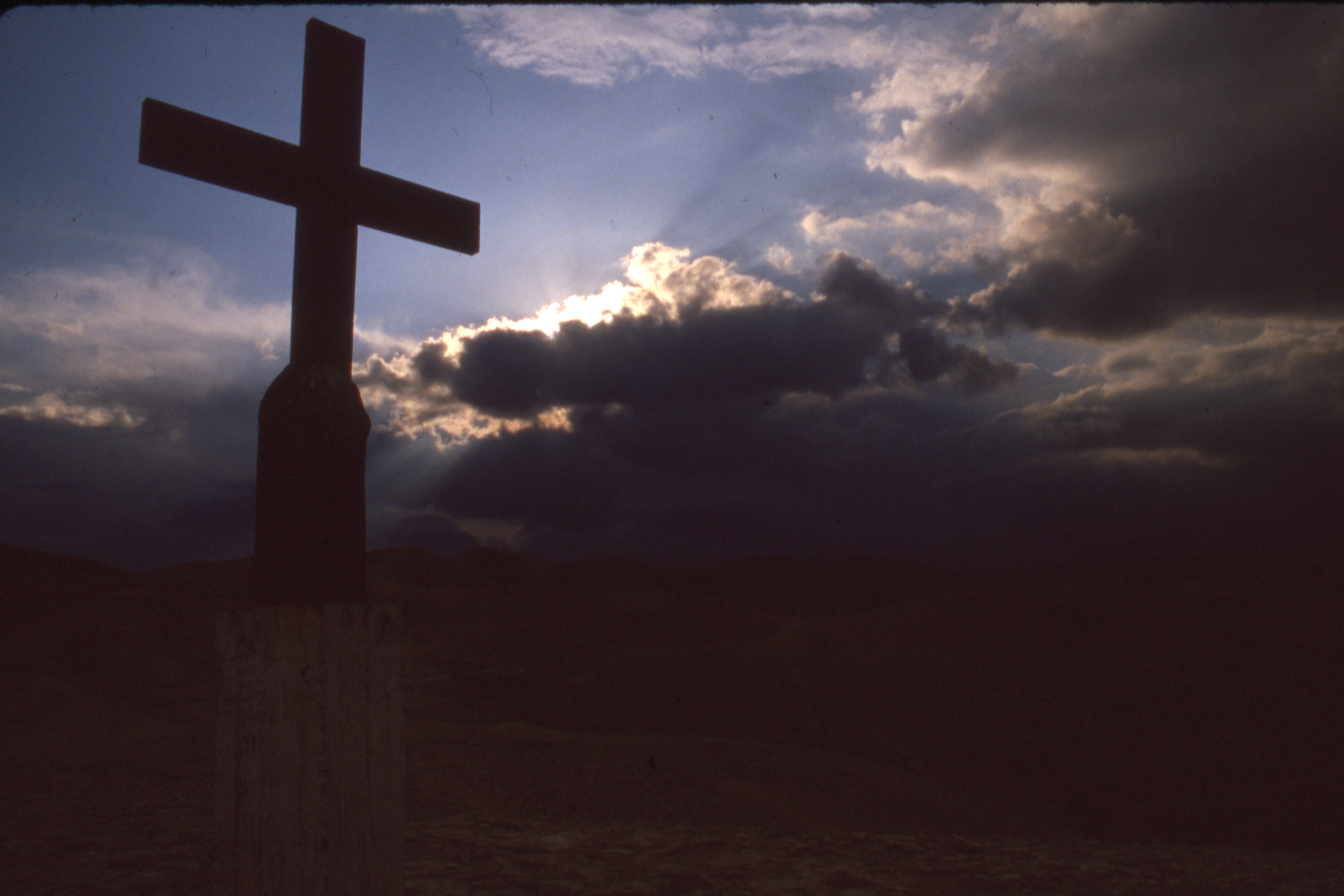
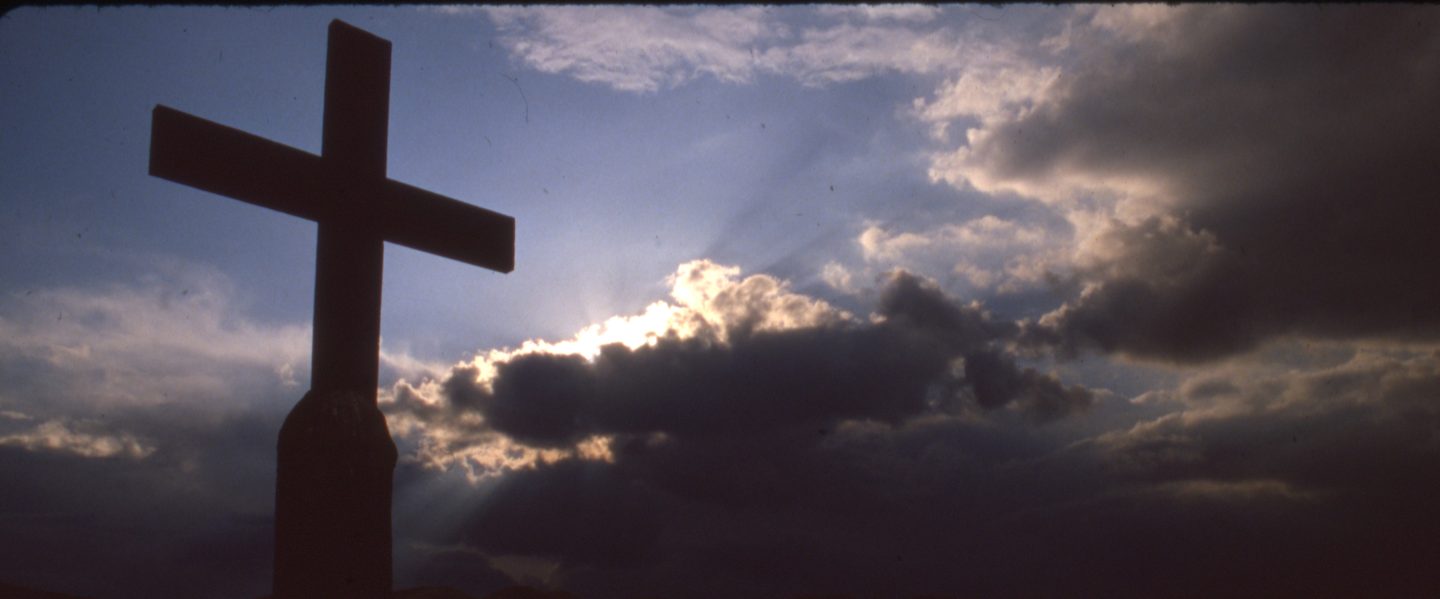
Lone Cross atop a mountain in east central California, a sunny day breaks through. (Wil Robinson, 1977)
Why is this all happening? If you haven’t figured it out yet, we who would attempt in any small way to follow in footsteps of Lord Y’shuaJesus, are going to find out that his footsteps lead not to prosperity of the material sort. We are not living and working and striving throughout our lives to retire to a nice cottage on a hill overlooking a tranquil valley covered with green grass and flowers. We are being led along a road that leads to trials and tribulations and eventually if we endure we will be granted a lovely death with Messiah on Calvary, or beheaded in the name of someone’s false god. Guess we missed that part when the alter call was made for all the hurting, lonely, empty people to come forward and accept the peace of the Savior of the world, Jesus! Well, there’s nothing to do now but suck it up. I like the way Thomas put it when the Lord’s other disciples were saying that it wasn’t safe to go to Jerusalem. Thomas said:
Let us also go, that we may die with him.
(John 11:16)
Seriously. What’s next. The hand writing is on the wall. We’ve been given various signs. We make a choice. We either offend people by our choice to be Christians First, or we offend Lord Y’shuaJesus, and be spit from His mouth for being lukewarm, neither hot nor cold. It begins with keeping our eyes toward heaven, toward the One seated upon the Throne, toward G-d through Lord Y’shuaJesus. Sure, we continue to pray from our family, our friends, our neighbors, our communities, our nation. We continue to pray and hope for revival in this land. Who knows, G-d may find more than ten in our modern-day Sodoms and relent, withholding his fury. It is our’s to continue in His Word as we walk in His steps. We must remember the courage of those who stood fast in the face of persecution. We must hold fast to the teachings of the Bible, putting away from us all that opposes it. And when all is said and done, we will endure. And in our enduring “to the end [we] will be saved. And this gospel of the kingdom will be proclaimed throughout the whole world as a testimony to all nations, and then the end will come. (Rev. 24:14) Hallelujah!
The wisdom books of the Bible, such as Proverbs, teach us that there is more to life than knowledge. Eleanor Roosevelt put it this way: “Never mistake knowledge for wisdom. One helps you make a living; the other helps you make a life.”
Today would be a good time to seek wisdom. Why today? Today is bound to be a full day; there are places to go, things to do, people to see. How about tomorrow? But is tomorrow going to be any different? In the Book of Proverbs, Wisdom is like a woman who cries in the street. The Book also tells of another woman who haunts the street. She is an adulterous lady that will captivate us, taking away our very soul, should she be allowed.
Captivate. It’s a good word. It means to attract and hold interest and attention. It means to charm. Synonyms are: enthrall, charm, enchant, bewitch, fascinate, beguile, entrance, enrapture, delight, attract, allure. These are not good things.
This woman that is opposed to Wisdom, this seductress, charms us, beguiles us. This reminds me of an old song first sung by the Exciters in 1963, Do-Wah-Diddy. It begins like this:
“There she was just a-walkin’ down the street
singin’ do-wah diddy-diddy down diddy-do
snappin’ her fingers and shufflin’ her feet
singin’ do-wah diddy-diddy down diddy-do
“She looked good, LOOKED GOOD
she looked fine, LOOKED FINE
she looked good, she looked fine and I nearly lost my mind
Before I knew it she was walkin’ next to me” (emphasis added)
What’s a man gonna do but lose his mind? That’s the Siren call. That’s the call of the “other woman” of the Book of Proverbs. How is the voice of Lady Wisdom to compete with this? Psalm 1 tells us:
Blessed is the man
who walks not in the counsel of the wicked,
nor stands in the way of sinners,
nor sits in the seat of scoffers;
but his delight is in the law of the Lord,
and on his law he meditates day and night
Here we see the problem, and it’s most likely result. In this case, Madame Seductress is counsel of the wicked. We listen, and we stand like sinners, finally sitting down with scoffers. We follow the counsel of the wicked to gain the world, and lose our souls.
Here we also see the solution: to be blessed, we must be enraptured by the Law of the LORD and in that Law we must meditate. The Apostle Paul put it this way:
Finally, brothers, whatever is true, whatever is honorable, whatever is just, whatever is pure, whatever is lovely, whatever is commendable, if there is any excellence, if there is anything worthy of praise, think about these things. Phil 4:8
We live today in desperate times. We live with encroaching darkness; the light of day is giving way. Pray for our brothers and sisters in Messiah who are persecuted for living The Word, for believing in the One True G-d our LORD. Many have died throughout the world. Many more are homeless, without food, sick. Pray also for the people of America, as the country is engulfed in darkness as mainstream churches follow Siren song, committing adultery against G-d, as they accept the ways of the world, rejecting the Authority of Scripture. Remember, we have nothing to fear, for these things must happen. And when the Time comes, our Lord and Savior, Y’shua will return. Maranatha!
Kaleidoscopes used to be a big thing for kids, yet I’ve not seen one in a while. As described by Wikipedia, “A kaleidoscope is a cylinder with mirrors containing loose, colored objects such as beads or pebbles and bits of glass. As the viewer looks into one end, light entering the other creates a colorful pattern, due to the reflection off the mirrors. Coined in 1817 by Scottish inventor Sir David Brewster, “kaleidoscope” is derived from the Ancient Greek καλός (kalos), “beautiful, beauty”, εἶδος (eidos), “that which is seen: form, shape” and σκοπέω (skopeō), “to look to, to examine”, hence “observation of beautiful forms.”
The Basic Elements of a kaleidoscope are: Colorful Images; Moving Images; Beautiful Images; Symmetrical Images. And if the technology had been available to Sir Brewster, he might have added soothing music to the collection, music for meditation. But the music isn’t necessary; it’s the bursts of color, constantly changing as the tube is rotated, that satiate the visual sense to such a point that the other senses are less acute, less active, less attention paid. In ways this is what television does to us as we watch. I remember when my parents brought home their first television. The actual viewing screen, the tube, was small, but the cabinet was very big. It was black and white, and we could watch one or two channels. I remember one night when I awoke from a nightmare and stayed up for a while watching the Phil Silvers Show. It was captivating enough that my nightmare fell away quickly into the hole of forgetfulness. And that was in black and white. It wasn’t until many years later that we had our first color television. Now that drew our attention. And for me it still does.
It happens when I’m at peoples homes who are unaccustomed to silence. Entering their homes I’d find a television in centrally located in the main room. In more than one home, I’ve found televisions strategically located throughout the house, even the kitchen. For me, the presence of a television, regardless to which station it is tuned, is a magnet for my attention. Sitting in a living room with several others having a conversation, I’d find myself constantly drawn to the TV, and I noticed so did the others in the room.
And televisions are appearing every where these days. They’re in restaurants. They’re in waiting rooms. They’re on buses and metro trains. I imagine them to line the streets some day. Oh, wait, that’s already happening with moving images on bill boards along highways. This reminds me of the child-care/pre-school up the road. It was only the second business to be opened along the rural road, and started with a small sign. Just this last year, the sign was replaced with an electronic bill board that scrolls various advertisements and slogans in bright lights. Even the schools and churches are putting up these electronic bill boards with bright scrolling advertisements crossing the sign. I wonder how many near-accidents have occurred while drivers tried to read the bill boards.
Maybe the reason there aren’t kaleidoscopes around any longer is that the world has become one big one. Everywhere we go, every where we turn, colorful images, moving images, beautiful images abound. There’s a saying, “can’t see the forest for the trees.” Today, we can not see the forest, we cannot see the trees, for all the images thrust before us, grabbing our attention. Aren’t we missing something through all this? Just like the kaleidoscope, our visual sense is overloaded to the point that our other senses are dulled. What would we feel, what would we hear, if we focused away from the images bombarding us?
In the second chapter of the Book of Proverbs (v.2), we are instructed to:
. . . make your ear attentive to wisdom.
The commentary in my Jewish Study Bible describes two lady personifications. One is Wisdom, the other the “strange woman,” that is Lady Folly, the symbol of wicked counsels and a figure for heresy, of foreign wisdom.
Like the television that is magnet for the eyes, images daily inundate our senses–we miss the call of Lady Wisdom and are seduced by the sensual pleasure offered our flesh by Lady Folly. We are being deceived. G-d is being undermined by fast-paced images beconing us toward the abyss.


 north of
  Kampala City in 2002. In his first service he was alone but now, praise be to God, they are many. Their vision is: To build the church of at least 500 people; To build an orphanage home of at least 100 orphans whose parents died AIDS\HIV and internal political wars; to build a Bible school (offering certificates and diplomas)
  and to build a primary school. They have already begun an Infant school. He requests prayer for the needs of the poor children in their area and the vision God has given them.