Questionable Broadcast Content

This evening I hung a wire indoors between two windows and wrapped one end around the antenna on my amateur radio hand-held radio–the one that also receives shortwave broadcasts.

I tuned around and found a lot of Spanish-language stations, a women interviewing another woman about Jazz with a Chinese element added, and then an Adventist Radio broadcast. I looked for some of the Christian broadcasts that I’d read about. Then I came to an announcer talking about tomorrow’s rally in Washington, D.C. I looked up the frequency that I’d tuned on shortwave station locator app on my android cell phone. It was from WWCQ, broadcasting from the State of Maine. This broadcast was on 7420 KHz (7.420MHz).

I’d heard a bit about this broadcaster; mostly that air time was reasonably priced and open to anyone who wants an hour on the air. The website for WWCQ posts its broadcast schedule. The program I’d tuned into turned out to be Jeffrey Daugherty’s UNidoctrinate Yourself. According to his website, which is subtitled “The Christian Whistleblower,” Mr. Daugherty is a former Christian minister of twenty years as well as a graduate of a Bible College. He also, according to the website, has over 100,000 hours of studying the Bible.

Mr. Daugherty’s experience and study “bring credibility to his stating that the bible keeps people locked in a Fear & Guilt Blood-Magick Mind Control Matrix. Mr. Daugherty will help “UNindoctrinate regarding Religion, ‘Scientific’ fallacies and the accepted Historical record–and to CREATE YOURSELF and live the life you’ll love through White Dianetics.”

Y’all see any red flags?

Pretty obvious, I’d say. But not everyone is so openly non-Christian. That’s exactly why Pastor Li (see previous article on JonahzSong Christian Fellowship is Booming; Zooming) said “there could be problems as believers became increasingly reliant on online materials that had been shared by sources from around the world. There had been cases in which believers “wrongly interpreted” certain concepts or became misled by cults that had elements of Christianity.


L-RD Bless, Keep, Shine. . .


Making Waves; Warming Clouds

When I was a kid, my family headed to Fort Leavenworth where Dad was to attend the Command and General Staff College. Crossing the desert we went many miles with nothing but static on the AM radio in the station wagon. It’s not that way anymore. Any one with XM satellite radio can listen to a wide selection of music, talk radio, news, and the Family Radio (Christian broadcasting) channel from coast to coast without interruption.

There was a time in the States when cars had another band in addition to AM called MF, which is a shortwave band. That ceased in the early 1950s when, allegedly, politicians didn’t want Americans to easily be able to listen to broadcasts from Communist Russia. Unlike the AM and FM radios, shortwave radios are able to receive broadcasts from around the world.

As technology changed giving us the internet and satellite radio, many people thought that shortwave broadcasting would drop off through disuse. It hasn’t. What I’ve noticed is that over the past year, with folks staying at home, there’s been a renewed interest in shortwave reception.

One of the first shortwave broadcasts I listened to is HCJB. “1931–On Christmas Day, the HCJB Radio Station begins transmitting with 200 watts of power from a remodeled sheep barn north of Quito. The broadcast was a combination of Spanish and English, and the program christened the HCJB Radio Station “La Voz de los Andes”, and included the hymn “Grande es Tu fidelidad,” according to its website.

In addition to expanding it’s transmission of the Christian message, it provided small receivers to enable people to listen to the broadcasts. Today, HCJB has a global reach in many languages, assists other organizations in establishing broadcast stations, and trains broadcasters. Unfortunately, from what I was able to find, HCJB no longer has English-language broadcasts to North America. It does have one in Australia, which might be possible to receive as the sunspot cycle returns to its highs.

There are other stations with broadcasts in English, and that are located in the States. One is WWCR, broadcasting from Nashville, TN. An example of a program it broadcasts is Truth For Life with Pastor Alistair Begg of Parkside Church. That program is broadcast at 8 am CT on 15.835 MHz (That’s in the 19 meter shortwave band.)

What does it take to receive these shortwave broadcasts? Looking on Amazon, for instance, there are still a number of reasonably priced shortwave receivers available. The cheapest at around $50 probably won’t work well. For $149 and up to $200, there are some that may work well. Like most electronics the sky’s the limit as far as cost. While the higher end receivers are going to be better in receiving, they also have many “bells and whistles” added.

A quick introduction to using one of these receivers. While many have short antennas attached to them, similar to the old AM-FM radios we used to take to the beach, they won’t really work all that well. Like the days of rural living and trying to get a TV station from the big city, it takes an antenna outside the house to work best. It can be a simple wire connected to the receiver and strung outside through a window stretched to a tree, for instance.


L-RD Bless, Keep, Shine. . .


Notes:

If interested in shortwave broadcast listing, called Shortwave Listening (SWL) there are a number of websites devoted to it. SWLing is but one of them.

Here’s a Wikipedia article: Shortwave Broadcasting in the United States, that may be of interest. I contains a listing of broadcasters, including some Christian.

With one of my hand-held amateur radios I was able to receive a few stations using the antenna on it. They were weak. I hope to find some time, perhaps use some saved during daylight savings time, and toss a wire out the window for a go at it. I do hope the HOA board doesn’t see it and complain.

I mentioned some ideas for local, small-church pastors to connect to their congregations apart from the internet. I’m working on that. Sorry.

Church in the Time of Covid

Church services, as well all know, have been disrupted for most of this year. While the internet certainly has offered a wonderful way for Bible teaching and preaching, it is not the only one. Additionally, watching or even listening to a church service via the internet is not available to all.

Pastor James, SlimJim, wrote about the need for equipping church members with the means to receive internet church here: Donate Electronic Device so At-Risk Members can have Church service online.

How have other churches reached their members apart from the internet? I’d like to hear about it. Please comment.

When Parkside Church began limited services at the end of August, it did so outside. Church was on the grass, with families physically distanced (don’t you like that term better than socially distanced? Courtesy of a Minnesota Epidemiologist.) Those who chose could simply park in the parking lot and listen. What, open windows and try to hear? No. On their car/truck radios.

Using a very low power FM transmitter is legal for use in the United States. Not all low-power transmitters on the AM and FM broadcast band that are sold on Amazon are actually legal, as they are not “Type Accepted” by the Federal Communications Commission (FCC). The FCC regulates broadcasts over the air in America.

Parkside’s transmission of a Sunday evening service to the parking lot was probably stretching the distance for which these low-power transmitters are useful. Of course, that’s the idea. License-free broadcasting is designed for a very limited use, also limiting its interference capabilities.

Some American manufacturers claim their products reach much farther, even a couple miles. However, this is pretty misleading, as the specifications by the FCC are such that the transmitters are not capable of such range. In fact, they must produce only the most minimal received signal at even 200 feet. Parked in a car under 200 feet from the church, the service might be heard, if the transmitter is legal in the US.

So Parkside, for instance, isn’t going to be able to broadcast throughout its community using its FM transmitter.

Pastor James might be able use a transmitter like this to reach at-risk members of his congregation, but only if they park in front of the church. This is possible. However, during the Spring, in Michigan, just parking in a parking lot was “illegal,” and subject to law enforcement action.

So, any other ways to reach out without internet?

The FCC has opened up a pathway for community broadcast stations. The licensing fees aren’t cheap, but much cheaper than commercial broadcast licensing, which is hard to get and can cost in the millions of dollars. Unfortunately, these community broadcast licenses aren’t all that easy to obtain either. From what I’ve read, the application process and review by the FCC is difficult, usually requiring experienced legal teams. And then there is the FCC review process, making it more difficult.

Two long-standing ways to broadcast a sermon are “buying air time” on local radio and television stations. Radio is by far cheaper. In Susanville, CA, in 1985-86, Lassen County Christians made thirty-second public service announcements (PSA) to reach out Christian messages. Local churches aired their sermons on Sunday morning. And larger churches in more populated cities had their Sunday service broadcast on a local television station.

For the last twenty something years I’ve not watched TV over the air, having subscribed to either cable TV or Satellite TV. These days, my wife and moved entirely to internet use. Perhaps there are some Sunday church services that are viewable in your area. As for the local radio broadcast stations near me, there two FM stations that broadcast exclusively Christian content, one mostly music, while the other does broadcast syndicated content from the large ministries.

Would a local radio station broadcast a pastor’s Sunday service, like back in the days before internet? Might be worth asking. However, it’s not going to be cheap. It’s not going to be affordable to a small church pastor that just wants to make sure his people are able to at least hear the Sunday Word.


Any other ideas? Yes. Next time, L-RD willin’


L-RD Bless, Keep, Shine. . .

Pilgrim Songs

In the Jewish Quarter of the Old City, Jerusalem, this arch commemorated a many-times destroyed Synagogue. It’s last destruction was in 1948 during the Arab-Israel War. After retaking the Old City in 1967, plans were made to build a new synagogue. The arch was erected in 1977. Finally, in 2010 a new synagogue was built and dedicated.
by Wil Robinson. 1987

For the last fifteen days, JonahzSong has looked at Psalms 120-134 collectively as the Songs of Ascent. In doing so, each has been seen from the perspective of The Temple service and Levites ascending the steps that led from the Court of the Gentiles upward toward The Temple, where Gentiles are not allowed.

Jamieson-Fausset-Brown Bible Commentary on Psalm 134 references this collection as the Pilgrim Psalms. Prior to the destruction of The Temple, Jews were to come up the Jerusalem for three Appointed Times. These are Pesach (Passover), Shavuot (Weeks or Pentecost), and Sukkot (Tabernacles, Tents or Booths)

I infer from the JFB commentary that the Pilgrims would be singing these Psalms as they made there way to Jerusalem.

How wonderful such a pilgrimage would have been, too. The words of Psalm 133, “Behold, how good and pleasant it is when brethren dwell in unity!” would echo through the hills. So marvelous!

I expect one day to make a final pilgrimage Jerusalemto a New Jerusalem where King Yeshua reigns. Oh, to sing those song with Brethren, to come The Feast, to dine with our L-RD, our King. Oh, how good it will be, how pleasant it will be, to truly dwell together in UNITY with King Yeshua.

Priestly Blessing

Song of Ascent: Fifteenth Step

At the Western Wall, upon which The Temple once stood, people gather to listen to a man’s prayers.
by Wil Robinson. 1987

Song of Ascent. Psalm 130

1 Come, bless the LORD, all you servants of the LORD, who stand by night in the house of the LORD!

2 Lift up your hands to the holy place and bless the LORD!

3 May the LORD bless you from Zion, he who made heaven and earth!

The final step, what a wonderful and joyous call! It’s an invitation. The call is for me. The call is for you. Are we not grateful we are called? Jew and Gentile alike. A call by our Heavenly Father made possible by His Son, our Savior, Yeshua Jesus! Blessed be His Name forever!

The pilgrim bands arriving at the sanctuary call on the priests, who stand in the house of the Lord—at the time of the evening sacrifice, to unite in praising God in their name and that of the people, using appropriate gestures, to which the priests reply, pronouncing the Mosaic blessing which they alone could pronounce. A fit epilogue to the whole pilgrim-book, Psalms 120-134. —Jamieson-Fausset-Brown Bible Commentary

Priestly Blessing

Song of Ascent: Fourteenth Step

At The Western Wall, Jews and Christians gather during The Feast of Sukkot (Tabernacles).
by Wil Robinson. 1987

Song of Ascents.
Of David. Psalm 133

1 Behold, how good and pleasant it is when brethern dwell in unity!

2 It is like the precious oil on the head, running down on the beard, on the beard of Aaron, running down on the collar of his robes!

3 It is like the dew of Hermon, which falls on the mountains of Zion! For there the LORD has commanded the blessing, life forevermore.

The first verse is beloved by many, and contained in favorite praise songs.

How lovely if we could hear the joyous voices of Levites on this fourteenth step of their ascent.

“. . .unity among brethren, whether civil or religious, is productive both of profit and pleasure. Of profit, because therein consists the welfare and security of every society; of pleasure, because mutual love is the source of delight, and the happiness of one becomes, in that case, the happiness of all. It is unity alone which gives beauty, as well as strength, to the state; which renders the church, at the same time, fair as the moon, and terrible as an army with banners, Song of Solomon 6:10.” — Horne, as quoted in Benson Commentary.

Priestly Blessing

Song of Ascent: Thirteenth Step

A blocked doorway. Temple Mount.
by Wil Robinson. 1987

Song of Ascents. Psalm 132
1 Remember, O LORD, in David’s favor, all the hardships he endured,
2 how he swore to the LORD and vowed to the Mighty One of Jacob,
3 “I will not enter my house or get into my bed,
4 I will not give sleep to my eyes or slumber to my eyelids,
5 until I find a place for the LORD, a dwelling place for the Mighty One of Jacob.”
6 Behold, we heard of it in Ephrathah; we found it in the fields of Jaar.
7 “Let us go to his dwelling place; let us worship at his footstool!”
8Arise, O LORD, and go to your resting place, you and the ark of your might.
9 Let your priests be clothed with righteousness, and let your saints shout for joy.
10 For the sake of your servant David, do not turn away the face of your anointed one.
11 The LORD swore to David a sure oath from which he will not turn back: “One of the sons of your body I will set on your throne.
12 If your sons keep my covenant and my testimonies that I shall teach them, their sons also forever shall sit on your throne.”
13 For the LORD has chosen Zion; he has desired it for his dwelling place:
14 “This is my resting place forever; here I will dwell, for I have desired it.
15 I will abundantly bless her provisions; I will satisfy her poor with bread.
16 Her priests I will clothe with salvation, and her saints will shout for joy.
17 There I will make a horn to sprout for David; I have prepared a lamp for my anointed.
18 His enemies I will clothe with shame, but on him his crown will shine.”

Do not the Levites step up and view The Temple and sing of a time when the The Ark was lost, and when found, remained in a tent?

They sing, too, of King David’s guilt at himself having a palace but no lasting House for Adonai.

Jewish commentators believe this is a “prayer David composed upon discovering the future site of the Bet Ha’mikdash (The Temple). As we read in the Book of [Samuel II (chapter 24) and the Book of Chronicles I (chapter 21), G-D delivered a deadly plague upon the Jewish people, and the prophet instructed David that he could end the plague by offering sacrifices in the granary of a Jerusalemite named Aravna (who was also known as Arnan). David purchased the land, built an altar and offered sacrifices, and the plague immediately came to an end. Thereupon David declared, “This is the House of the L-RD G-D, and this is Israel’s altar for burnt offerings!” [Chronicles I 22:1]. Indeed, that spot became the site on which the Bet Ha’mikdash was built during the time of David’s son and successor, King Solomon.”—Daily Tehillim.

In verse 14, according to Expositors Bible Commentary, “the psalmist asked for favor to the anointed, and God replies by expanded and magnificent promises. The “horn” is an emblem of power.”

And “Victory will attend the living representative of David, his foes being clothed by [G-D] with shame-i.e., being foiled in their hostile attempts-while their confusion is as a dark background, against which the radiance of his diadem sparkles the more brightly. These large promises are fulfilled in Jesus Christ, of the seed of David; and the psalm is Messianic, as presenting the ideal which it is sure shall be realized. and which is so in Him alone.

Priestly Blessing

Song of Ascent: Twelfth Step

Child in Old City Jerusalem.
Photo by Wil Robinson. 198
8

Psalm of Ascent. Psalm 131

1 O LORD, my heart is not lifted up; my eyes are not raised too high; I do not occupy myself with things too great and too marvelous for me.

2 But I have calmed and quieted my soul, like a weaned child with its mother; like a weaned child is my soul within me.

3 O Israel, hope in the LORD from this time forth and forevermore.

On this step, we hear the Levites sing a song of David in which he “briefly testifies that he did not conduct himself with the kind of arrogance and egotism that are generally associated with leadership and author.” (Daily Tehillim)

All who govern are under the ultimate authority of G-D. Israel’s King David modeled the proper relationship of a governor, which is one of being a dependent subject to the G-D of Abraham, Isaac, Jacob, the Father of Yeshua our Messiah and King.

Priestly Blessing

Song of Ascent: Eleventh Step

Looking down, 2500-year-old stones in an excavated area of Old City Jerusalem.
Self-Portrait. Wil Robinson. 1987

Song of Ascent. Psalm 130
1 Out of the depths I cry to you, O LORD!
2 O Lord, hear my voice! Let your ears be attentive to the voice of my pleas for mercy!
3 If you, O LORD, should mark iniquities, O Lord, who could stand?
4 But with you there is forgiveness, that you may be feared.
5 I wait for the LORD, my soul waits, and in his word I hope;
6 my soul waits for the Lord more than watchmen for the morning, more than watchmen for the morning.
7 O Israel, hope in the LORD! For with the LORD there is steadfast love, and with him is plentiful redemption.
8 And he will redeem Israel from all his iniquities.

In their ascent from the Court of the Gentiles, the Levites step now onto the eleventh step. They enter the last section of five steps.

The Expositor’s Bible Commentary begins:
“In a very emphatic sense this is a song of ascents, for it climbs steadily from the abyss of penitence to the summits of hope. It falls into two divisions of four verses each, of which the former breathes the prayer of a soul penetrated by the consciousness of sin, and the latter the peaceful expectance of one that has tasted God’s forgiving mercy. These two parts are again divided into two groups of two verses, so that there are four stages in the psalmist’s progress from the depths to the sunny heights.”


Priestly Blessing

Song of Ascent: Tenth Step

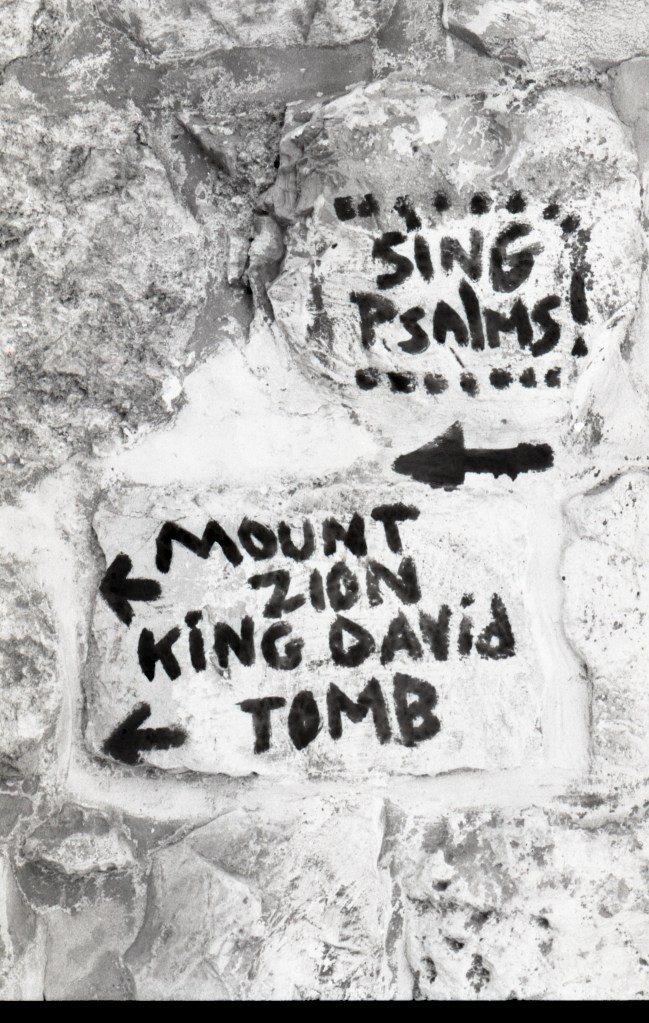
Sign pointing the way. Outside the Old City Jerusalem. Photo by Wil Robinson, 1988

A Song of Ascent. Psalm 129.

1 “Greatly have they afflicted me from my youth”— let Israel now say—
2 “Greatly have they afflicted me from my youth, yet they have not prevailed against me.
3 The plowers plowed upon my back; they made long their furrows.”
4 The LORD is righteous; he has cut the cords of the wicked.
5 May all who hate Zion be put to shame and turned backward!
6 Let them be like the grass on the housetops, which withers before it grows up,
7 with which the reaper does not fill his hand nor the binder of sheaves his arms,
8 nor do those who pass by say, “The blessing of the LORD be upon you! We bless you in the name of the LORD!”


“There is nothing in [this Psalm] which would forbid us to suppose that it was composed on the return from the Babylonian exile, but there is nothing to fix it definitely to that event. Why it was made one of the “Songs of Degrees” is equally unknown. It merely refers to the fact that Israel had often been roughly and severely treated; and it contains a prayer that those who were the enemies of Zion might be punished in a proper manner.”
Barnes’s Notes

Despite Rev. Barnes’s statement regarding not knowing why this Psalm is included among the Psalms of Ascent, it has been included. Therefore, G-D sees it as fitting, and fitting for the tenth step in the Levites ascent. They’ve climbed two thirds of the way from the lower section of the Court, the Court of the Gentiles. They are leaving behind the worldly, ascending toward the divine. Yet they also have in their minds where they’ve been and how it has been the L-RD Who has enabled every step.


L-RD Bless, Keep, Shine. . .